Upholstery piping is a fabric-covered cord used to finish and outline upholstered furniture. There are two main kinds: single piping, sewn into the seams between two pieces of fabric (around cushions, on an outside back, along the arms), and double piping, two cords side by side, fixed as a finish along the visible wood of a chair to hide the staples or tacks. Piping is also called welt, welting or cording, and beading in some places.
In this guide, I explain each type of piping, where to use it, and how to choose between making it and buying it. Looking for colour ideas? See the power of piping, with real chairs in coral, turquoise, bold and soft contrast piping.
On this page: Single piping · Double piping · Micro piping · Comparison · Make or buy · Tutorials · FAQ
Single Piping: Where Two Fabrics Meet
Single piping is one cord wrapped in a strip of fabric, with a seam allowance (the flange) left free. It is sewn into a seam, between two pieces of fabric, so that only the rounded cord shows. It strengthens the seam, protects the edge from wear and underlines the shape of the piece.
Where to use single piping:
- Around cushions: seat cushions, boxed cushions and decorative cushions.
- On an outside back, between the back panel and the sides.
- Along the arms of fully upholstered armchairs, such as a club chair.
- On headboards, stools and poufs, around the top panel.
- In short: basically everywhere there is a seam.
Double Piping: the Finish Along the Wood
Double piping is made of two cords side by side, wrapped in the same strip of fabric. It is not sewn into a seam: it is a finish, fixed along the edge of the fabric where it meets the visible wood of the chair. Its job is to hide the staples or tacks that hold the cover, and to give a clean, neat line between the fabric and the wood.
Double piping is one of the different ways to finish a seat, alongside braid (gimp) and decorative nails. Compared with braid, it gives a more modern, graphic line; compared with nails, a softer one.
Where to use double piping:
- Along the show wood of French chairs: cabriolet chairs, medallion backs, bergère frames.
- Around seats, backs and arm pads wherever the fabric stops against wood.
- Anywhere you would otherwise use braid or decorative nails to hide the fixings.
When a chair needs both
A bergère, with its visible wooden frame and its loose seat cushion, is the perfect example of a chair that uses both: double piping along the wood, and single piping around the cushion.
Micro Piping and Other Options
- Micro piping: a single piping made with a very thin cord, for a delicate line on smaller pieces or finer fabrics.
- Same fabric or contrasting fabric: piping in the same fabric underlines the shape discreetly; a contrasting colour turns it into a design feature. See the power of piping for examples.
- Leather piping: on leather chairs, the piping is cut from the same skins, as on a leather club chair.
Single Piping, Double Piping, Braid or Nails?
| Finish | How it is attached | Where it goes | Look |
|---|---|---|---|
| Single piping | Sewn into a seam | Cushions, outside backs, arms, borders | A fine rounded line that underlines the shape |
| Double piping | Fixed as a finish over the fixings | Along the visible wood | A clean, graphic line between fabric and wood |
| Braid (gimp) | Fixed as a finish over the fixings | Along the visible wood | Classic and decorative |
| Decorative nails | Nailed through the fabric | Along the wood or the frame edge | Bold, traditional or graphic |
Make Your Piping or Buy It?
Making it yourself means you can use exactly the same fabric as the chair, or any contrasting fabric you like. I cut the piping strips at the same time as the rest of the cover, so everything is ready when I start covering.
Buying it ready-made saves time: general upholstery suppliers and trimmings specialists offer single and double piping in a wide range of colours.
To sew piping, a sewing machine with a piping foot or a zipper foot is enough for most fabrics. For leather and very thick fabrics, see the perfect sewing machine for upholstery work.
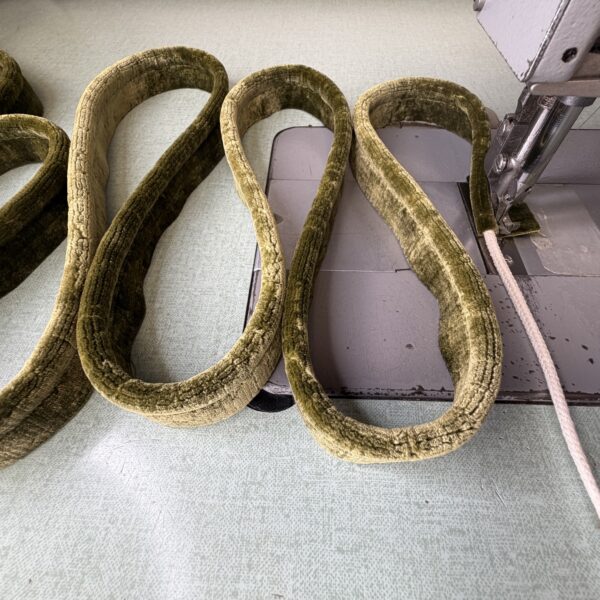
How to make upholstery piping, step by step
Piping Tutorials
- How to make upholstery piping step by step
- How to start attaching piping
- How to sew a decorative cushion with piping
- How to sew a boxed cushion
- How to make and fix double piping: coming soon in the Hammer Club.
Find all the techniques for the final touches in the finishing tutorials and the sewing tutorials.
Upholstery Piping: Frequently Asked Questions
What is the difference between piping and welting?
None: they are the same thing. “Piping” is the usual term in the UK, “welt” or “welting” in the US, and “cording” or “beading” are also used.
What is the difference between single and double piping?
Single piping has one cord and is sewn into a seam, for example around a cushion. Double piping has two cords side by side and is used as a finish along the visible wood of a chair, to hide the staples or tacks.
Can double piping replace braid?
Yes. Double piping, braid and decorative nails all do the same job: hiding the fixings along the wood. The choice is a question of style.
Should piping be the same fabric as the chair?
It can be either. The same fabric gives a discreet, tailored finish; a contrasting colour turns the piping into a design feature. See the power of piping for real examples.
How much piping do I need?
Measure every edge and seam that will receive piping, then add a margin for joins and corners. For example, a cabriolet chair takes about 6 m (6½ yd).
Written by Céline Vanier, upholsterer trained with the Compagnons du Devoir, working in her atelier near Lake Annecy, France, since 2012.