
A modern upholstered chair is reupholstered like any other chair: strip it, rebuild the foam padding, cover it and finish it cleanly. The one real difference is the frame. Most modern chairs come apart into separate seat and back panels, so the job starts with careful disassembly and ends with putting the chair back together.
Mid-century accent chairs, contemporary dining chairs with a padded back, vintage lounge chairs on a wooden or metal frame: they look nothing like a cabriolet or a bergère, but the upholstery logic is the same. This page explains what changes on a modern chair, the order of the work, and which tutorial to follow at each stage.
Modern chairs are some of the most satisfying reupholstery projects because the transformation is so dramatic. A tired foam and faded fabric becomes something that looks brand new, and nobody can tell it wasn’t always that way.
On this page: What is a modern chair? · Wooden or metal frame · Before you start · The order of the work · The seat · The back panel · Which fabric? · Is it for beginners? · FAQ
What is a modern upholstered chair?
In upholstery terms, a modern chair is any chair with a fully upholstered seat and back that isn’t a traditional French armchair. That covers a wide range: a 1950s Scandinavian-inspired accent chair on tapered wooden legs, a contemporary dining chair with a padded back panel, a mid-century lounge chair on a chrome frame, or a simple cushioned side chair with a removable back.
What they have in common: the upholstered parts are built around panels that come off the main structure, by unscrewing a wooden back panel for example. That is what sets them apart from a bridge chair or a simple dining chair. Once you know how to take the chair apart cleanly and put it back together without damaging the frame, the upholstery itself is very accessible.
Wooden frame or metal frame: what changes?
Wooden frame chairs
On most wooden modern chairs, the seat and back panels unscrew or detach from the frame. It is a gift for the upholsterer: you work on each panel flat on the table, without going around the rest of the chair. Keep track of every screw and fixing, and take a photo before you start stripping: it saves a lot of guesswork at the end. The finish is clean, because the fabric edges are hidden once the panel goes back on the frame.
Metal frame chairs
You can’t staple into metal. On a metal frame, the upholstery is usually built on a separate board that sits inside the frame, or the fabric is held with clips, bolts or both. Before stripping, study how the original upholstery was attached: it tells you exactly how to redo it. Once the fixing method is clear, the padding and covering are the same as on a wooden chair.
What should you check before you start?
Take a good look at your chair before you touch anything. A few minutes of inspection will shape your whole approach:
- Can the back panel be removed, and how is it attached?
- Is the seat a fixed panel or a loose cushion?
- Is the foam still usable? Press it: if it doesn’t spring back, replace it. On mid-century chairs, the foam has often hardened or crumbled with age.
- Wooden or metal frame? It decides how the fabric will be attached.
In what order do you reupholster a modern chair?
- Take the chair apart and note how every panel is fixed.
- Strip the old fabric and foam: how to strip like a pro.
- Rebuild the foam padding on the seat and the back (see the seat and the back panel below).
- Cover each panel: how to cover a modern chair.
- Finish the outer back cleanly, and add a bottom liner under the seat.
- Put the chair back together. If a wooden joint has come loose, glue it back first.
How do you redo the seat: fixed or removable cushion?
The seat of a modern chair is either a fixed padded panel, or a loose cushion. The approach is different for each.
Fixed padded seat
A fixed seat is built on the frame or on a panel attached to it. Strip the old fabric and foam, replace the foam, and cover it as you would a dining chair seat. The tutorial below covers the foam padding step by step, on the seat and on the back panel.
Modern cushion chair tutorial
Removable cushion seat
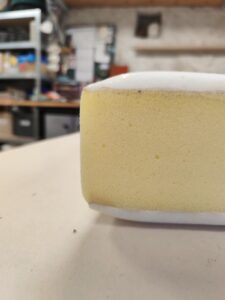
A loose cushion is a slightly different project: you sew a cover instead of stapling fabric to a panel. The result is more refined, and the cushion can be taken off for cleaning. For a well-structured cushion, the three-layer foam method gives the best result: firm support at the base, comfort in the middle, and a soft top layer that holds its shape. A piped edge gives it a neat, tailored finish.
How to create a perfect 3 layers foam seat cushion
How do you redo the back panel?
The back panel is where the work shows most, and where the finish has to be cleanest. On a wooden panel that comes off the frame, both sides can be visible once it is back on, so the outer back needs a clean finish: backtacking or a hand stitch, the same technique as on the back of a bridge chair.
The back foam is always thinner than the seat: usually 3 to 5 cm (1¼ to 2 in), depending on the chair’s proportions. Keep the original thickness if you can measure it. A back that is too thick will stop the panel from going back cleanly onto the frame.
Which fabric suits a modern chair?
This is where you can really have fun. The clean lines of a mid-century or contemporary frame make bold choices look intentional. A cabriolet calls for a certain refinement; a modern chair is open to experimentation.
- Velvet, especially in a saturated colour against wood or metal.
- Bouclé: its texture complements the clean structure.
- A bold geometric or a large-scale print.
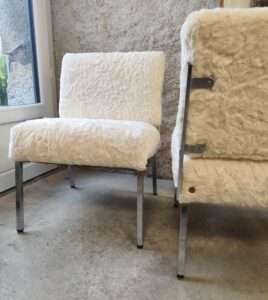
- A statement texture like shearling or faux fur, as on the chair in the complete tutorial.
Whatever you choose, it needs enough body to hold its shape over the foam without pulling or distorting. My complete guide to upholstery fabric explains how to check that before you buy.
The complete tutorial: a modern cushion chair, step by step
The full tutorial covers the whole job on a modern chair with a wooden frame: disassembly, stripping, new foam on the seat and back, covering with a clean finish on every panel, and reassembly. It works as a guide for most modern chairs with detachable wooden panels, whatever the exact style.
Is a modern chair a good project for a beginner?
A modern chair is an easy to moderate project. Taking it apart adds a step that a simple dining chair or a stool doesn’t have, but once the panels are off, the upholstery is very manageable. If you have already done a simple seat or a bridge chair, you are ready. If it is your very first project, start with a foam pouf or a dining chair seat, or follow the beginners guide with three complete projects.
Which other chairs can you reupholster?
- Stools and simple chairs, the easiest way in
- Bridge chairs, with a padded back and wooden arms
- Cabriolet chairs and bergères, traditional French armchairs
- Voltaire armchairs, in traditional padding or in foam
- Club chairs and upholstered headboards
Frequently asked questions
Do I have to take a modern chair apart to reupholster it?
Usually yes, when the seat and back are panels that unscrew from the frame. It makes the work much easier: each panel is upholstered flat, and the fabric edges are hidden once it goes back on.
Can I reuse the old foam?
Only if it still springs back when you press it. On older chairs, especially mid-century ones, the foam has often hardened or crumbled, and it needs replacing.
How thick should the foam be on the back?
Usually 3 to 5 cm (1¼ to 2 in), thinner than the seat. Keep the original thickness if you can, or the panel may not fit back onto the frame.
How do you attach fabric to a metal frame?
You can’t staple into metal. The upholstery is usually built on a separate board inside the frame, or held with clips or bolts. Look at how the original was attached before you strip it, and do the same.
What is the best fabric for a modern chair?
Velvet, bouclé, a bold print or a textured fabric all work well, as long as the fabric has enough body to hold its shape over the foam. See the upholstery fabric guide.
Learn with me
All the tutorials on this page are available in full with the Membership, with video and step-by-step photos for every stage. Questions about your own chair? Share a photo in the forum and we’ll look at it together.