
How to reupholster a bridge chair
| Project | Seat |
| Piece | Bridge chair |
| Style | Art Deco |
| Technique | Both |
| Level | Beginner |
| Stages covered | Prepare · Webbing & Springs · Padding · Covering · Finishing |
| Traditional padding | 3 h |
| Foam padding | 2 h |
| Covering & finishing | 5 h |
| Fabric | 1 m (about 1.1 yd), 140 cm (54 in) wide |
| Trim | 150 cm Welting cord (optional), around the outside back |
| Decorative nails | 40, at least on the top of the legs |
A bridge chair is a small armchair with wooden arms, and one of the chairs I see most often around me. The technique is much the same as for any simple chair, with one difference: the back is padded too. Here are the steps in order, with the tutorial you need for each one.
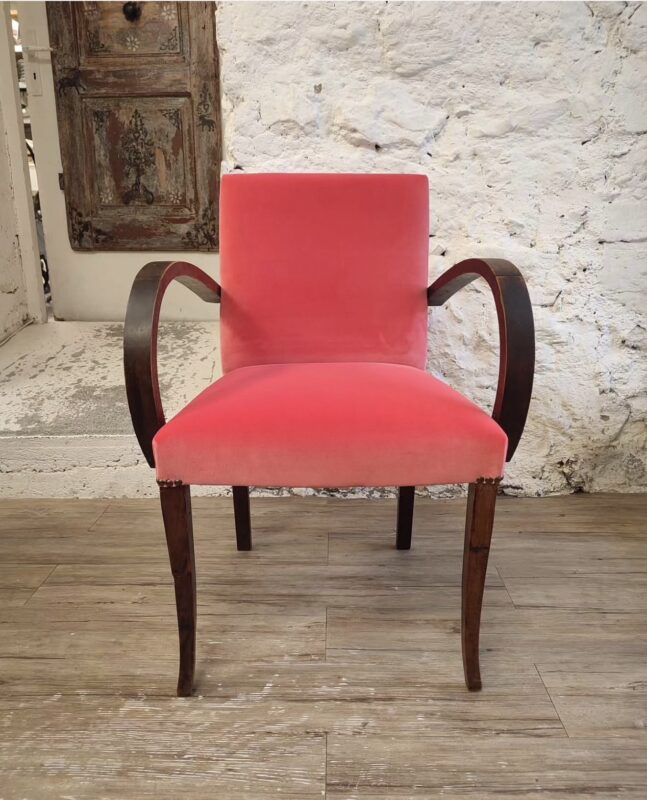
Before you strip anything: assess your chair first
This is the step most people skip, and it’s the one they most often regret. Before you remove a single tack or pull off any fabric, take a good look at what you actually have. Is the back padding still in decent condition? Are the arms solid or do they need attention? Do the springs need replacing or can you work with what’s there?
Many beginners strip a chair completely only to realise the arms were perfectly fine and didn’t need touching. Know your plan before you start. It saves time, materials, and a lot of frustration.
If one of the arms is damaged or has come loose, sort that out before anything else. Here’s how to fix a broken arm before you begin the upholstery work.
What does your project actually need?
Not every bridge chair needs a full redo. The right approach depends on what condition your chair is in. Here are the most common scenarios:
- Your chair just needs to be plumped a little: the padding is still good but the seat has lost its firmness.
- Your back just needs a fresh layer: the foam is still serviceable but needs topping up before covering.
- You need a full new seat with elastic webbing and foam: the most common and most practical approach for a bridge chair.
- You want coil springs and foam for a more traditional, longer-lasting seat.
- You just need to do a re-cover: the padding is fine, you only need new fabric.
Take your time with this decision. The tutorials below are organised so you can pick exactly the path that matches your chair.
Fabric and materials: what you need
For a standard bridge chair, 1 metre of fabric at 140 cm wide is generally enough. You’ll also need a few decorative nails to secure the fabric cleanly at the legs, and optionally a welting cord if you want a neat finish around the back. For a full overview of fabric choices and what works best on this type of chair, see the bridge chair guide.
The seat: two approaches
My preferred approach for a bridge chair seat is elastic webbing with foam, or coil springs with foam. In this specific case, I find traditional fibre padding alone is neither the most comfortable option nor the most durable. Here’s how to do both.
Option 1: elastic webbing and foam
Option 2: coil springs on traditional webbing, then foam
- Fit the traditional webbing
- Position the springs
- Tie the springs
- Sew the springs to the hessian
- Pad the seat with foam
The back
The back is where the bridge chair requires the most attention. Because it’s fully covered on both sides, the outer back panel needs a clean, invisible finish, either hand-stitched or using the backtacking technique. There’s no trim to hide a messy edge here, so take your time with this step.
If you need to build a completely new back, use the foam padding tutorial: the process is the same as the seat, just with a thinner foam.
If the existing back padding is still in good shape, add a fresh top layer before covering. It makes a real difference to the final result without the work of a full rebuild.
Covering the chair
Once your seat and back are padded and ready, it’s time to cover. This is where all the preparation pays off. A well-tensioned fabric on a clean, even padding base is the difference between a professional finish and one that looks homemade.
Two techniques you’ll use during this stage:
- How to create a clean pleat on a squared edge seat: essential for the corners of the seat.
- The clove hitch knot: a small but useful technique that comes up regularly during the covering stage.
For the full covering process from start to finish, follow the bridge chair covering tutorial.
Step 1: Strip the chair
If you can, remove the arms: you will avoid ugly cuts in the fabric later. Here is my advice for stripping like a pro.
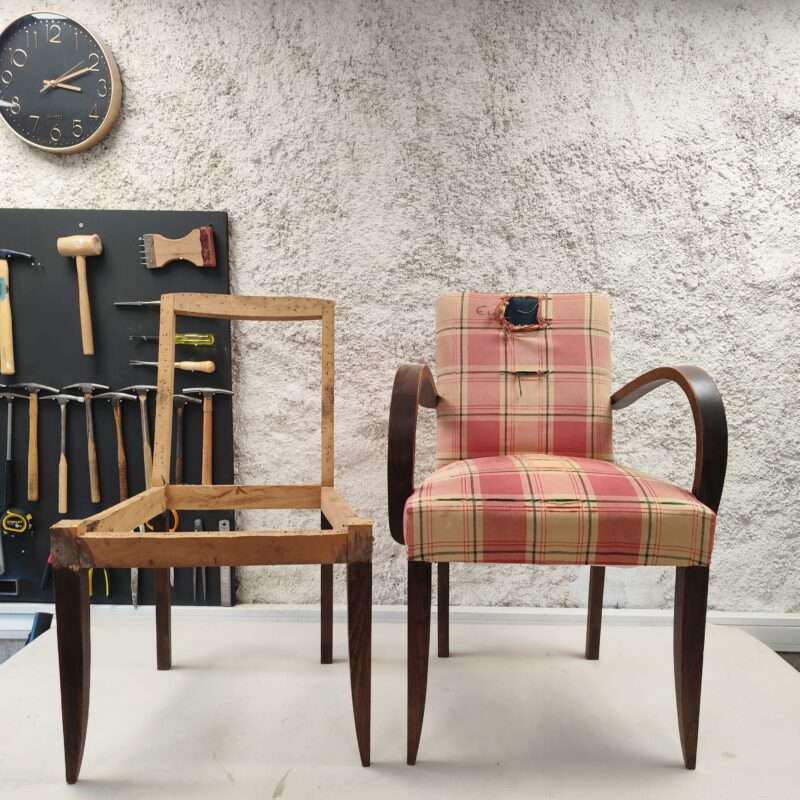
Step 2: Webbing, with or without springs
When you start from the bare frame, you have several options. The first question to ask, even before rushing to your favourite upholstery supplier: with or without springs?
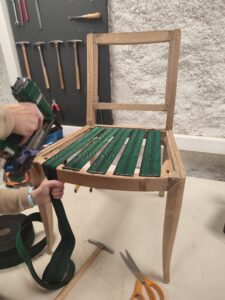
How to web with elastic webbing
Option A: with springs
With springs, the webbing goes under the frame, to leave room for the springs. First position the springs on the seat, then follow the simple springing technique.
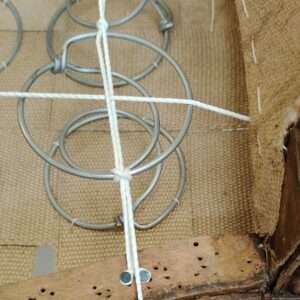
Simple springing technique
Option B: without springs
Without springs, the webbing goes on top of the frame. You can use jute webbing, or elastic webbing to give the seat some flexibility.
How to web with elastic webbing
Step 3: Padding the seat and the back
Option A: natural fibres
You can stuff the seat and the back with natural fibres, the traditional way.
Option B: foam
Or you can make a foam seat. In that case, make a pattern of the seat once the webbing is done. If you need a firm edge, add firm foam along the edges.
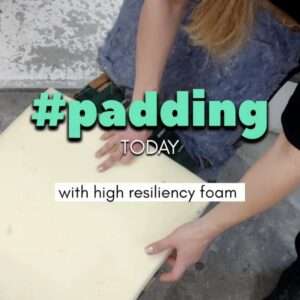
How to upholster a modern chair seat with foam easily
Step 4: Covering
Now cover the chair. Don’t forget to finish with a bottom liner under the seat.
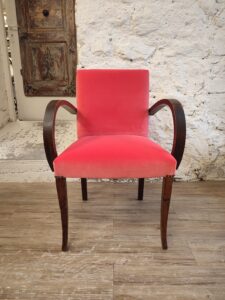
How to cover a modern bridge chair (3 videos tutorials)
Step 5: Glue the arms back
Last step: glue the arms back on.
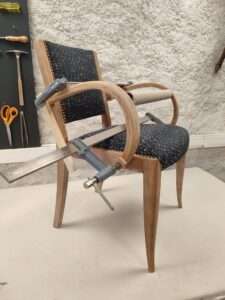
Fixing and gluing back the wood
The bridge chair is one of the most satisfying upholstery projects you can take on, whether you’re just starting out or looking for a project that delivers great results without the complexity of a more ornate frame. The structure is logical, the steps are clear, and the finish is immediate. This page walks you through everything: how to assess your chair, which approach to take for the seat and back, and how to cover it cleanly from start to finish.
Not sure what a bridge chair actually is or whether yours qualifies? Read the bridge chair guide first, then come back here when you’re ready to get started.
The complete step-by-step tutorial
Members have access to the full bridge chair restoration tutorial, with video and photo documentation of every stage from stripping to final finish. If you want to follow the whole process in one place without piecing it together from individual tutorials, that’s where to go.