
Padding is the stage that gives a seat its shape and its comfort. There are two families: modern padding with foam, wrapped in Dacron, and traditional padding, built in layers of natural fibres (coir, tow, horsehair, cotton felt) held with twine and stitched edges. Foam is faster, more accessible and the best place to start: it suits most chairs, drop-in seats and seats under a loose cushion. Traditional padding is for the more daring, and for period chairs restored the way they were made.
Everything before this stage, the webbing and the springs, was structure. Padding is where comfort begins, where the eye starts to see the shape, and where the hand of the upholsterer becomes truly visible. This page gathers every padding tutorial, in the order you will need them.
On this page: Which padding? · Before you start · Foam padding · Foam pouffes · Traditional padding · Cushion interiors · FAQ · What comes next
Which padding for your project?
| Foam padding | Traditional padding | |
|---|---|---|
| Materials | Foam, Dacron, edge roll, wadding | Coir, tow, horsehair, cotton felt, hessian, twine |
| Best for | Modern pieces, drop-in seats, pouffes, seats under a loose cushion | Period chairs, stitched edges, restorations that respect the original |
| Look | From sharp and graphic to soft and generous, depending on the layers | Domed seat, crisp stitched edges |
| Skill | More accessible, but cutting and layering take care | Takes practice: stuffing, regulating, stitching |
| Time | Faster | Longer |
Quick guide by piece:
- Dining chair with a drop-in seat: foam. Start with changing the foam on a dining chair.
- Small chair or flat wooden back: foam on a wooden frame, or fibres the easy way.
- Cabriolet or Voltaire armchair: a built-up stuffed seat, traditional or in foam with edge roll.
- Bergère, sofa or any seat with a loose cushion: a front foam edge, then a well-made cushion interior. See the bergère tutorial guide.
- Pouffe: foam, with or without a wooden structure.
Before you start: webbing and springs
The padding can only be as good as what sits underneath it. If you have not done your webbing or your springs yet, start there: webbing tutorials and springs tutorials.
With or without springs? On a sprung seat, the padding builds on top of the hessian-covered springs: its role is to refine the shape and add a comfort layer over an already resilient base. On a seat without springs, the padding must create both the support and the comfort, directly on the webbing. The materials and techniques are the same; what changes is the thickness, the layering and the amount of work.
Modern padding with foam: the best place to start
Materials: foam, Dacron, edge roll and wadding
Foam is not one single thing: density, firmness, thickness and the way layers are combined all give very different results. A single dense block gives a firm, graphic seat; softer foam on top with Dacron wrapped around reads as a deep, generous cushion. Learn how to choose it in which foam for upholstery, and see every material in the upholstery materials guide.
Tools for foam padding
- Electric carving knife or foam cutter: a sharp blade makes all the difference on thick blocks.
- Contact or foam spray glue for bonding foam layers together and fixing foam to the frame or edge roll.
- Edge roll for a firm, defined perimeter, needed when the foam padding is higher than 5 cm.
- A staple gun for fixing Dacron and calico to the frame.
- Scissors and a long ruler for marking and cutting accurately. Always take a template of the seat first, so the foam fits from the first cut.
Changing the foam on a dining chair
The drop-in seat is the most common foam job, and the one most people attempt first. Remove the old foam cleanly, choose the right density for daily use, cut it to the frame and finish with Dacron: a simple project that transforms a chair.

How to reupholster a dining chair seat for beginners (drop-in seat)
Padding a wooden frame with foam
A simple, efficient method for a small chair, a back or any flat wooden surface: foam selection, cutting, fixing and finishing with Dacron. A great first foam project.
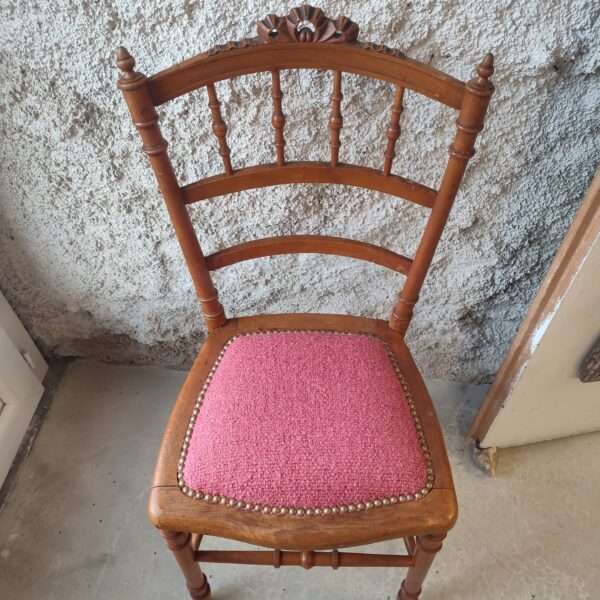
How to cover a chair with a solid wooden seat
A foam seat with edge roll on an armchair
The complete process on a cabriolet, with or without springs: the edge roll creates a clean perimeter before the foam goes on, for a firm, well-shaped seat with edges that hold their line.

How to do a foam seat with edgeroll
A front foam edge for seats with a loose cushion
On sofas, bergères and deep armchairs, the front edge of the seat needs its own foam build to support the cushion and give the piece its shape.

How to create a front edge platform
Arms with foam
The easiest way to pad the arms of a cabriolet or a bergère.
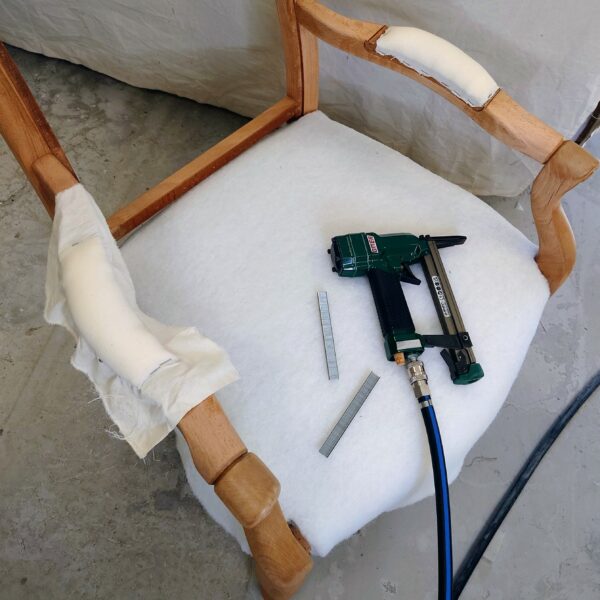
The easiest way to upholster arms with foam
Foam pouffe projects
A round foam pouffe
No frame, no springs, no webbing: just foam, cut and assembled into a solid form, then wrapped and covered. One of the most satisfying projects to make from scratch.

How to make a foam pouf
A round pouffe on a wooden structure
When the pouffe has a wooden base, the foam works with the structure rather than replacing it: how to pad and shape the curves for a smooth result.

Rounded stool tutorial (wooden structure)
More pouffes and stools in the stool upholstery tutorials.
Traditional padding with natural materials, for the more daring
Comfortable with foam and ready for a challenge? Traditional padding is slower and takes practice, but it is the way period chairs were made, and there is nothing quite like a hand-stitched seat.
Materials: coir, horsehair, cotton felt and more
Traditional padding is built in layers, each with its own role: coir fibre or vegetable tow as a first stuffing to create volume, horsehair as a second stuffing for refinement and resilience, and cotton felt or skin wadding as a final layer to smooth everything before the fabric goes on. Understanding why the layers exist is what allows you to adapt them to any piece. All the natural fibres are explained in traditional stuffing with natural fibres.
Tools for traditional padding
- Curved and straight mattress needles for bridle ties, edge rolls and through-stitching.
- The regulator: a long metal spike used to redistribute and even out the filling through the hessian without removing it. It is how you correct lumps, adjust density and refine the shape before stitching.
- Upholstery twine for bridle ties and edge stitching.
- Jute hessian (burlap) as the first layer over the springs or webbing.
- Upholstery pins to hold layers in place while you work.
- Scissors for trimming hessian, calico and wadding cleanly.
The traditional stitched seat
A traditional seat is built in stages. The first stuffing, anchored with bridle ties sewn into the hessian, creates the basic volume and dome of the seat: getting the density and the crown right here saves a great deal of correction later. The stitched edge roll, built into the padding with a long mattress needle and twine, then gives the seat a firm edge that holds its shape under the fabric, one of the defining marks of traditional upholstery. The junctions between the front edge and the sides are the trickiest points to get clean, and make all the difference once the fabric goes on.

First stuffing on a cabriolet chair
How to stitch a square angle
A perfectly crisp corner that holds its shape requires a specific stitching sequence and a precise use of the regulator, broken down step by step.

Arms with horsehair
Arms are smaller and more curved than seats, and the padding must stay in place without bulk. This tutorial builds the arms of a cabriolet chair with horsehair over a calico base, a technique that applies to many classic French and English chairs.

How to create arms with horsehair
The well back
The padded inner back of a fully upholstered armchair has its own logic: the padding must be built evenly on a vertical surface, held securely, and shaped to receive the fabric without shifting. From the first layer to the finished calico.

Well back tutorial
Padding a small chair with fibres, the easy way (coming soon)
Not every chair needs the full traditional build. For small salon chairs and simple seats, a faster approach gives a clean, comfortable result: ideal for a first real piece.
Cushion interiors: seat and scatter cushions
A loose cushion is only as good as what is inside it. The interior decides the shape, the feel, and whether the cushion still looks plump after months of use. You can make it yourself, or order a made-to-measure interior from a supplier.
Feather and down: a baffled interior
The most luxurious option: soft, generous, with that yielding feel foam cannot replicate. The key is the construction: internal walls called baffles keep the feathers evenly spread and stop the cushion from going flat in the centre.

How to create a feather seat cushion
A simple fibre or feather interior
The most versatile interior: a fabric case filled with polyester fibre or feathers. How much filling, how to sew it, and how to get a plump look without overstuffing. For scatter cushions, back cushions and anywhere a soft, relaxed feel is the goal.

How to sew a simple inside cushion
A 3-layer seat cushion for comfort and shape
For seat cushions that must hold their shape under load, on a sofa, a deep armchair or a window seat: a firm foam core for support, a softer foam or fibre wrap for comfort, and a final Dacron layer for a generous, slightly rounded silhouette.

How to create a perfect 3 layers foam seat cushion
Upholstery padding: frequently asked questions
Traditional padding or foam: which is better?
Neither is better in itself. Foam is faster, more accessible and the right choice for most projects, especially to start. Traditional padding respects period chairs and gives stitched, domed seats: keep it for when you want a challenge. Choose by the piece and the result you want.
Can I pad a seat without springs?
Yes. The padding then sits directly on the webbing and must create both the support and the comfort, so it is built thicker.
When do I need an edge roll with foam?
When the foam padding is higher than 5 cm: the edge roll gives a firm, defined perimeter that keeps the seat’s line.
What is a regulator used for?
To move and even out the stuffing through the hessian, without taking it out: it corrects lumps and refines the shape before stitching. See how to use a regulator.
Which is the easiest padding project to start with?
Changing the foam on a dining chair seat. Then move on to a foam pouffe or a small chair. All beginner projects are in Guide 1.
What comes next?
The padding is done: the seat has its shape, its volume and its comfort. Now comes the part everyone sees: the fabric, the cuts, the corners, the piping, the pleats, the braid or decorative nails, the outside back and the bottom cloth, the last gesture before the piece leaves the bench.
→ Covering
Fabric placement, tension, cuts at the legs and arms, pleats and corners: where all the previous work becomes visible.
→ Finishing
Piping, braid, double piping and decorative nails: the details that define the quality of the final piece.
→ Tools and materials
Not sure which foam density or which natural fibre suits your project? Everything you need before you start.
Written by Céline Vanier, upholsterer trained with the Compagnons du Devoir, working in her atelier near Lake Annecy, France, since 2012.
Learn upholstery in three steps
Start with a simple project, learn the techniques behind every seat, then take on complete chairs.
Guide 1
Beginners
Simple, forgiving projects that teach the basics: cushions, seats and easy chairs. Ideal if you have never upholstered before.
Start with Guide 1Guide 2
Techniques
The steps professionals use every day: prepare, webbing, springs, padding, covering, finishing and sewing.
Explore the techniquesGuide 3
Projects
Complete projects from frame to finished piece: stools, cushions, headboards, chairs and armchairs.
See the projectsAll of these techniques, and many more, are available in full detail inside the Hammer Club. Every tutorial is filmed step by step in my workshop, on real pieces, so you can follow along at your own pace, pause, rewind, and come back whenever you need a refresher.