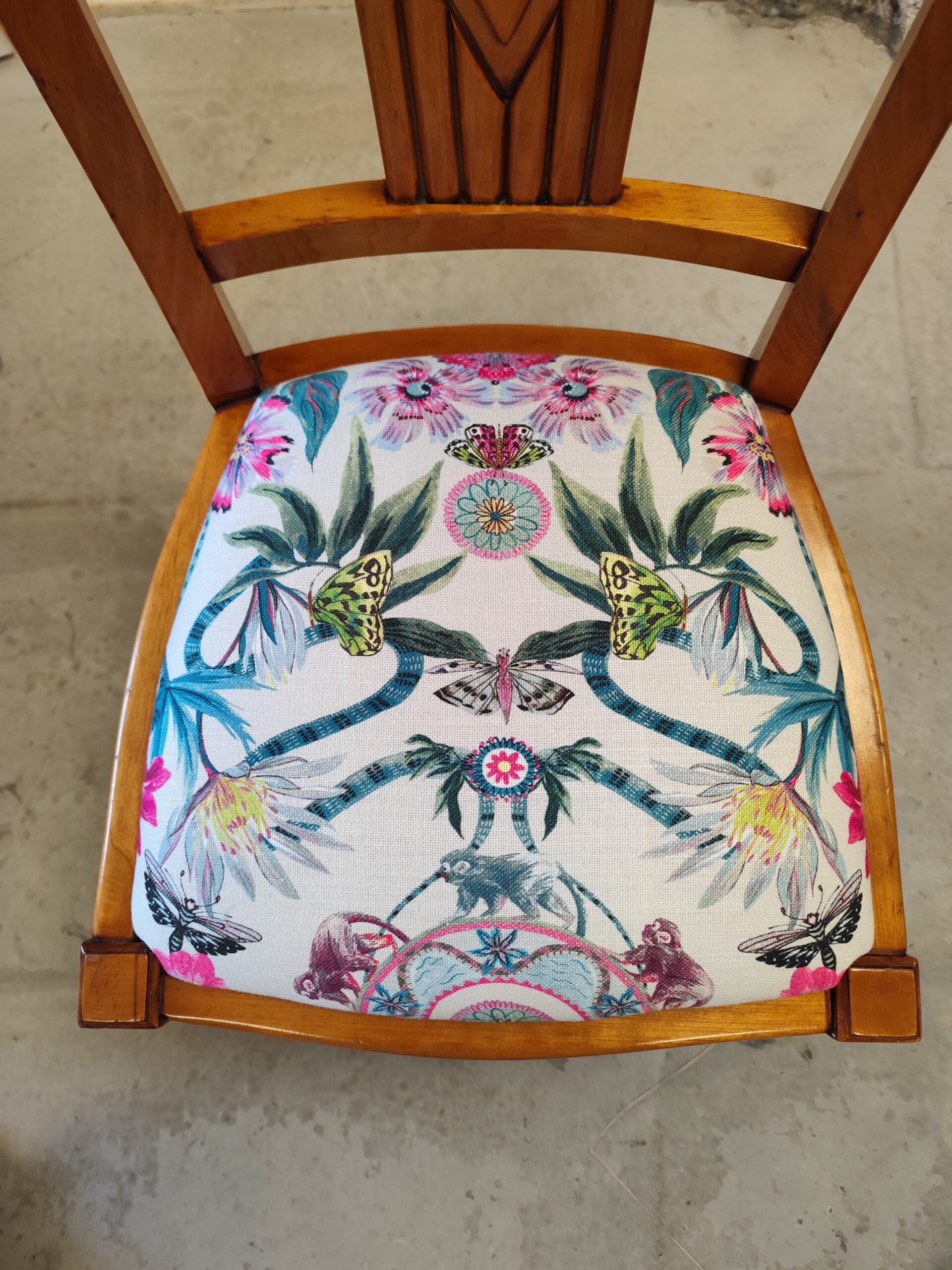
To reupholster a dining chair seat, lift the drop-in seat out of the chair, strip it back to the wooden frame, rebuild the base (webbing on an open frame, nothing on a solid one), add foam and wadding, then stretch your new fabric over it and staple it underneath. It’s the perfect first upholstery project: simple enough to finish in a day, and full of techniques you’ll use on every chair afterwards.
| Project | Dining chair, drop-in seat |
| Level | Beginner |
| Technique | Modern (foam) or traditional (natural fibres) |
| Stages | Stripping · Webbing · Padding · Covering |
| Materials | Webbing (open frame only) · Foam · Wadding · Upholstery fabric · Dustcover |
| Tools | Staple gun · Staple remover and scissors · Foam saw · Drill (solid frame) |
| Fabric | About 0.7 m (¾ yd), 140 cm (54 in) wide |
On this page: What is a drop-in seat? · Open or solid frame? · Stripping · Webbing · Padding · Covering · FAQ
Reupholstering a drop-in seat is one of the most rewarding projects in upholstery, and for many people it’s the one that shows how far a little technique can take you. It looks simple, and compared to a fully sprung armchair or a buttoned headboard, it is. But that simplicity is exactly what makes it the perfect starting point: every decision you make on a drop-in seat, from the type of frame to the way you pull your fabric, teaches you something you’ll use on every project that follows.
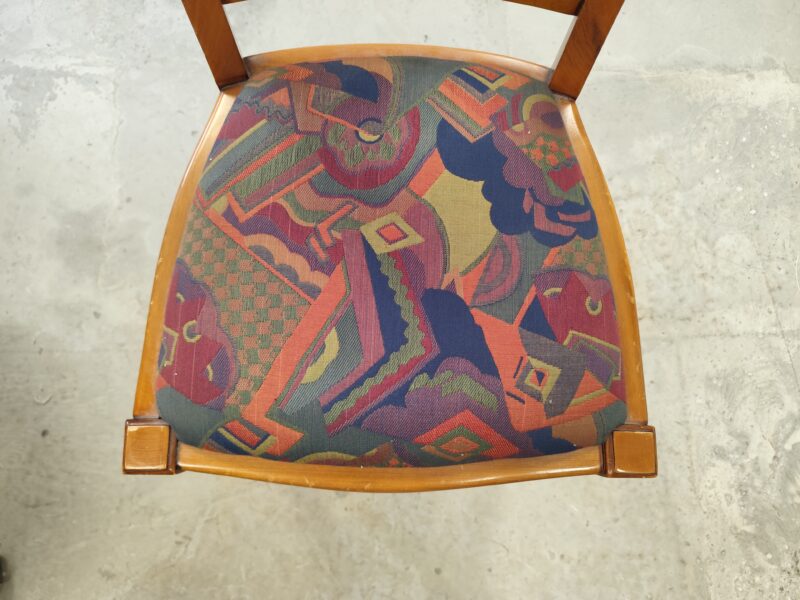
Simple doesn’t mean approximate, though. Even on a basic dining chair seat, the difference between a rough DIY result and a clean, professional finish comes down to method, sequence and control. That’s exactly what the step-by-step tutorials of the Hammer Club are here to teach you.
What is a drop-in seat chair?
A drop-in seat chair is a chair whose seat is removable: it sits inside the frame of the chair instead of being fixed to it. The seat literally drops into the structure, which is where the name comes from. You can recognise it easily:
- the seat lifts out of the frame;
- it’s often held from underneath with screws, or simply rests in a rebate;
- the chair and the seat are two completely separate pieces.
This construction is extremely common on dining chairs. It makes reupholstery much more accessible, because you work on the seat on its own, without handling the whole chair. Not sure what kind of chair you have? See the different types of chairs.
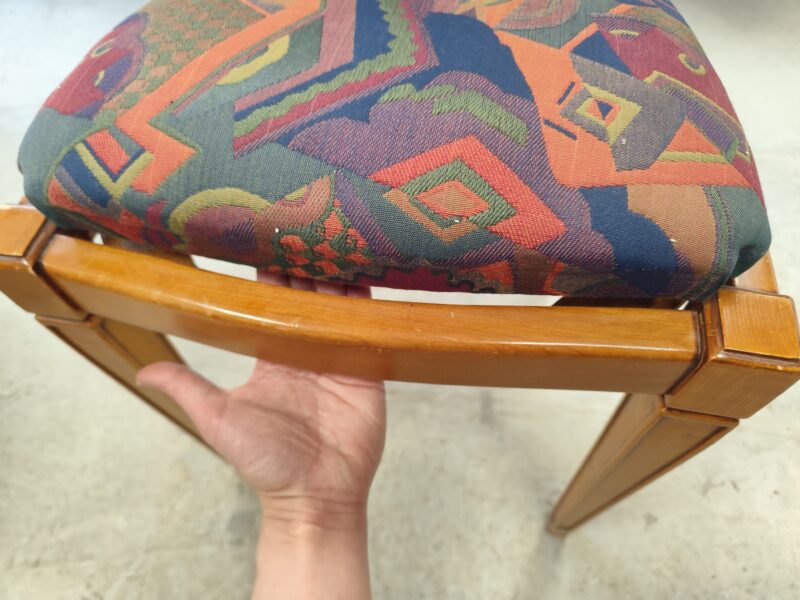
Open frame or solid frame: which one do you have?
Before you remove a single staple or cut a piece of foam, identify your frame. Not all drop-in seats are built the same way, and the type of frame decides how you build up the padding.
The open frame (webbed frame)
An open frame is a wooden border with an empty centre: no base at all. Here, webbing is not optional. It’s the foundation of the seat: without it, your foam and fabric have nothing to sit on, and it carries the weight of whoever sits on the chair.
You can use jute webbing, the traditional approach, interlaced and tacked, or elastic webbing, a more modern method, faster to apply and naturally springy. Both work well, but they need different tools, techniques and tensions, and choosing the wrong one or applying it badly affects both the comfort and the life of your seat.
The solid frame (plywood or solid wood base)
A solid frame has a full wooden base, usually plywood or solid wood, covering the whole seat. It’s the most common type on mass-produced dining chairs. No webbing is needed: you go straight to the padding.
But there’s one detail many beginners overlook: ventilation. When foam sits directly on a solid base under tightly stretched fabric, air gets trapped underneath. That pressure affects comfort and can make the foam wear out faster. The solution is simple: drill one or two holes through the base before you start, so air can circulate under the foam every time someone sits down. It takes thirty seconds and makes a real difference to both comfort and durability. It’s exactly the kind of detail that separates a well-built seat from one that feels flat after a few months.
Step 1: Should you strip just the fabric, or everything?
It depends on the condition of your seat. Sometimes you can keep the existing padding. But most of the time, old chairs hide compressed materials, dust, or several uneven layers stacked up over the decades.
Stripping everything back to the bare wooden frame usually gives a much cleaner, more controlled result. It also shows you exactly what you’re working with: the type of frame, its condition and what it needs. Removing staples isn’t the most pleasant job, but with the right tools and technique you’ll get there.
Step 2: Do you need webbing?
Now that you know your frame, the answer is obvious. Open frame? Webbing is essential, it’s your base. Solid frame? Skip the webbing, go straight to the foam, and remember to drill those ventilation holes first.
Whatever the frame, the goal is the same: a stable, well-supported base before you add a single layer of foam or fibre. Rushing this step is the most common reason drop-in seats end up flat or uneven after a few months. See jute webbing, elastic webbing and my webbing tip for a series of drop-in seats.
Step 3: Which padding should you choose?
Once your base is solid, it’s time to think about the padding. At the very least, replacing the top layer of wadding under the fabric already makes a visible difference. But for a truly well-built seat, think about the whole padding stack. There are two main options.
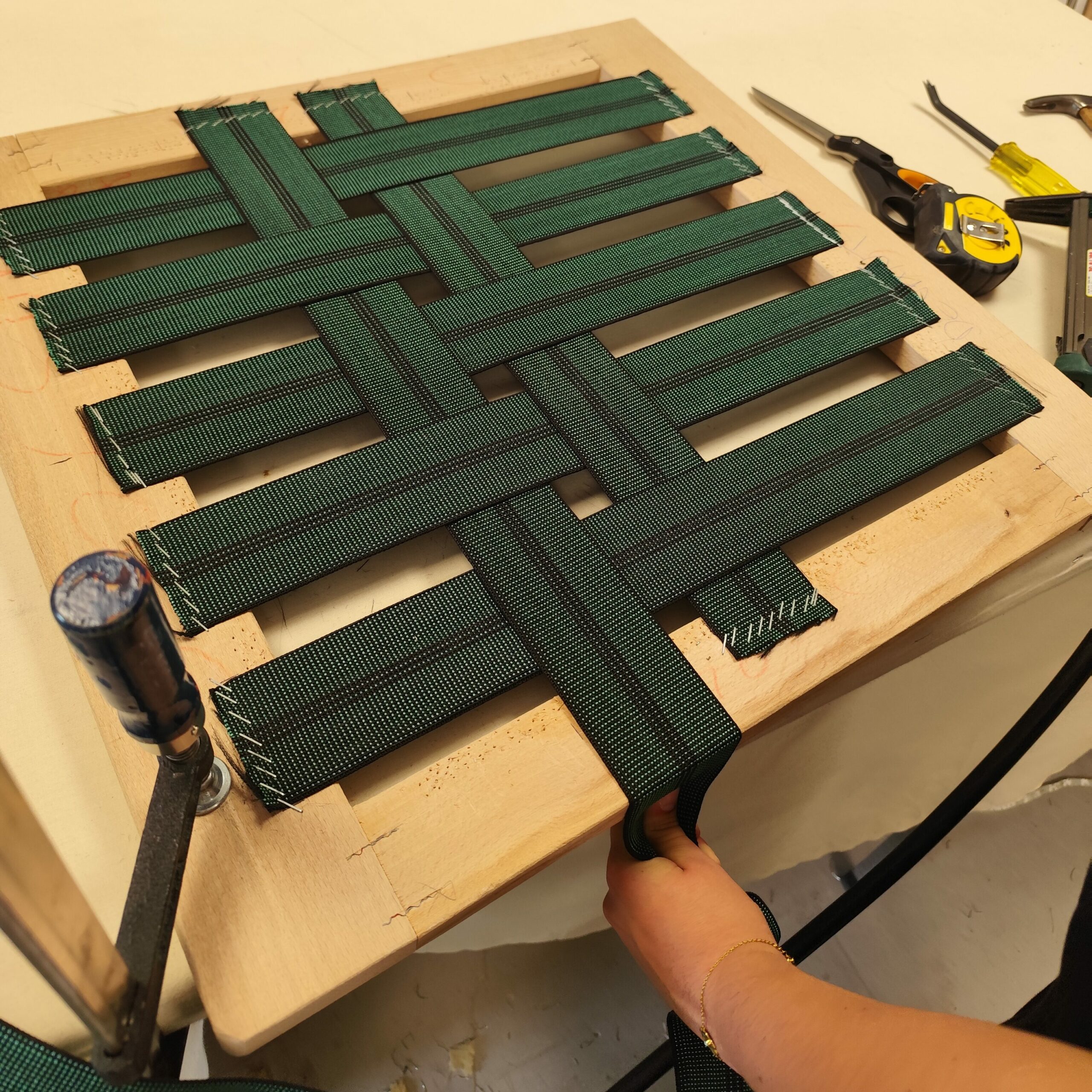
Webbing and foam (or foam on a solid base)
The most accessible approach for beginners, and the one used on most modern dining chairs. Foam is easy to cut and glue, and gives a clean, consistent result. Its density and thickness decide the comfort of the finished seat, and choosing the right foam is one of the upholsterer’s real skills. For a curved seat, see how to upholster a shaped drop-in seat with foam.
Webbing and natural fibres
This is the traditional approach, with layers of natural materials such as horsehair, cotton felt and curled fibre. It gives a beautiful, breathable seat with a softer, more nuanced feel than foam, but it asks for more control, more patience and a good understanding of how the layers work together. It’s not where a complete beginner should start, but it’s an incredibly satisfying technique to learn once you have the basics.
At this stage, the most important thing isn’t to do everything at once: it’s to choose the method that suits your frame, your materials and your level. To compare them, read how to choose the right padding.
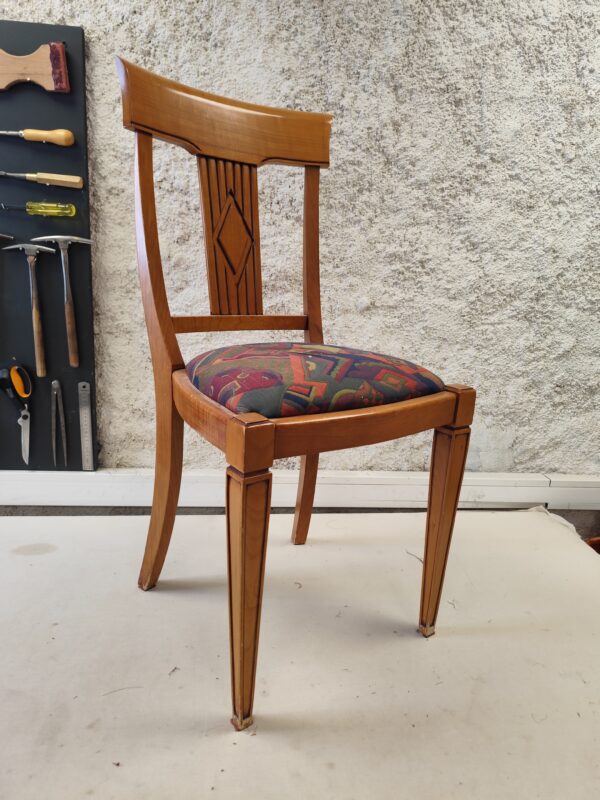
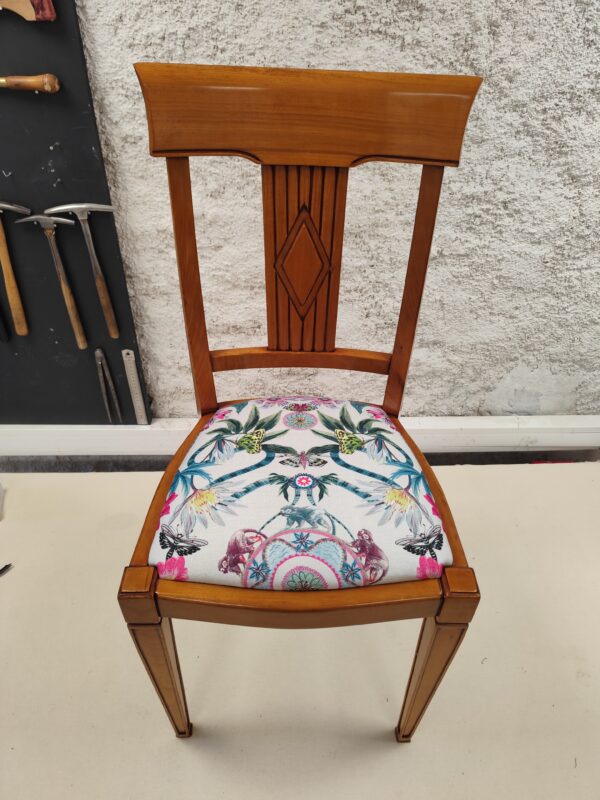
Step 4: How do you cover a drop-in seat neatly?
This is where the final result takes shape, and where the gap between a beginner and someone who has learned the right technique shows immediately.
Covering isn’t about stapling fabric as fast as possible. It’s about controlling the tension, working in the right order, and understanding how the fabric behaves as you pull it. Temporary tacking, placing tacks or staples loosely before committing to the final position, is one of the most important habits you can build. It’s also the one most beginners skip.
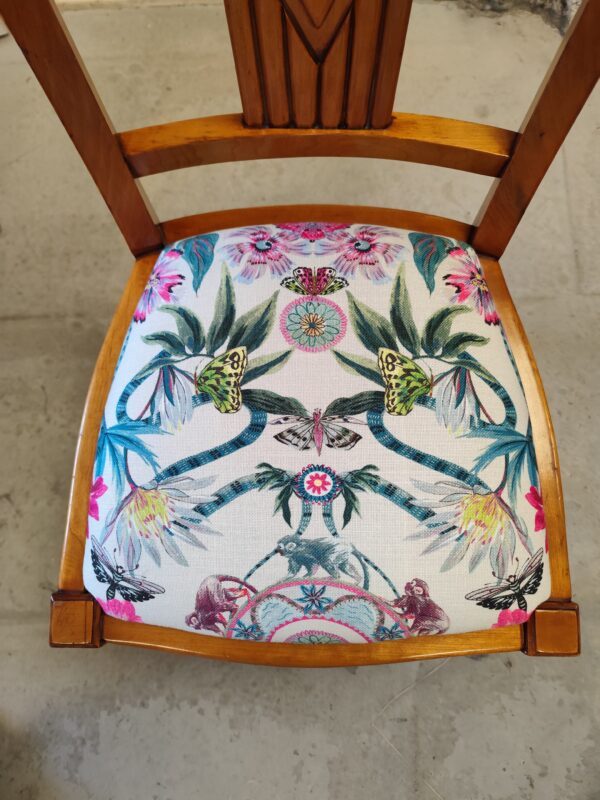
It’s also where most people struggle. Small mistakes, a slightly uneven tension or a corner pulled at the wrong angle, lead to wrinkles, distorted shapes and a finish that looks handmade in the wrong sense of the word. On a drop-in seat, the corners are folded underneath and must stay flat so the seat drops back into the chair: see how to fold a drop-in seat corner and how to cover a mitered corner.
Special cuts
Seats are rarely perfectly square. Rounded corners, slight curves and irregular shapes all need specific cuts to get a clean result, without bunched fabric or unsightly folds. Getting this right is what turns a recovered seat into one that looks professionally made. See how to cut the fabric on a seat and the guide to corners and pleats.
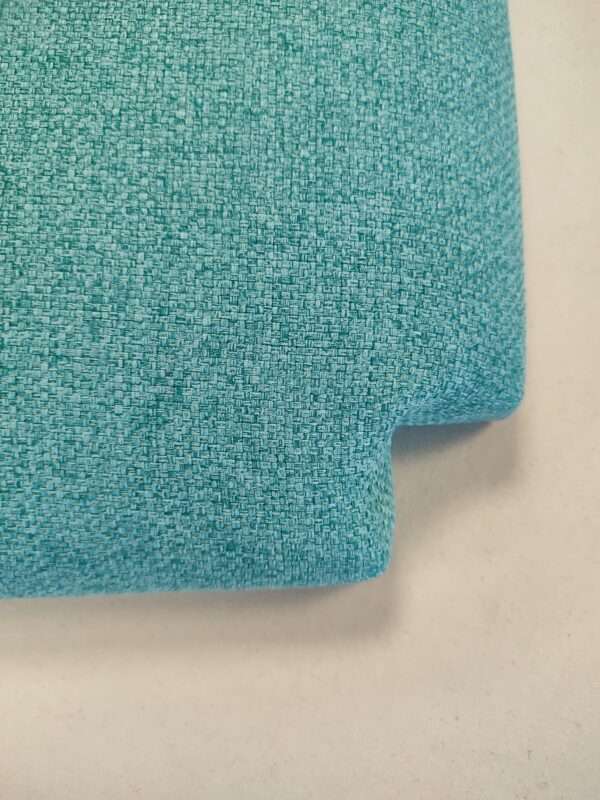
This is where upholstery stops being about recovering a chair and becomes real craft. The details make all the difference, and they can be learned.
FAQ
How much fabric do I need for a dining chair seat?
About 0.7 m (¾ yd) of fabric 140 cm (54 in) wide for a standard seat. For a set of chairs or a large pattern, check with the fabric calculator.
Can I keep the old padding?
Sometimes, if it’s still even and firm. But old seats often hide compressed, dusty or uneven layers, and stripping back to the bare frame almost always gives a cleaner result.
Why drill holes in a solid seat base?
To let the air out. Without them, air trapped under the foam creates pressure every time someone sits down, which affects comfort and wears the foam out faster.
Is a drop-in seat a good first upholstery project?
Yes, it’s the ideal one. You work on a small, removable piece, and you learn stripping, webbing, padding, tension and corners. Then move on to the other projects in Guide 1, or read the complete guide on how to reupholster a chair.
Ready to do it properly?
You now have a clear picture of what a drop-in seat involves. But reading about it and doing it well are two different things. Inside the Hammer Club, you’ll find the exact gestures, sequences and decision points that lead to a truly professional finish, whether you’re working with foam on a solid base, jute webbing on an open frame, or natural fibres. Every step is filmed and explained, so you can follow along with confidence, whatever your level. Find every drop-in seat tutorial in one place.