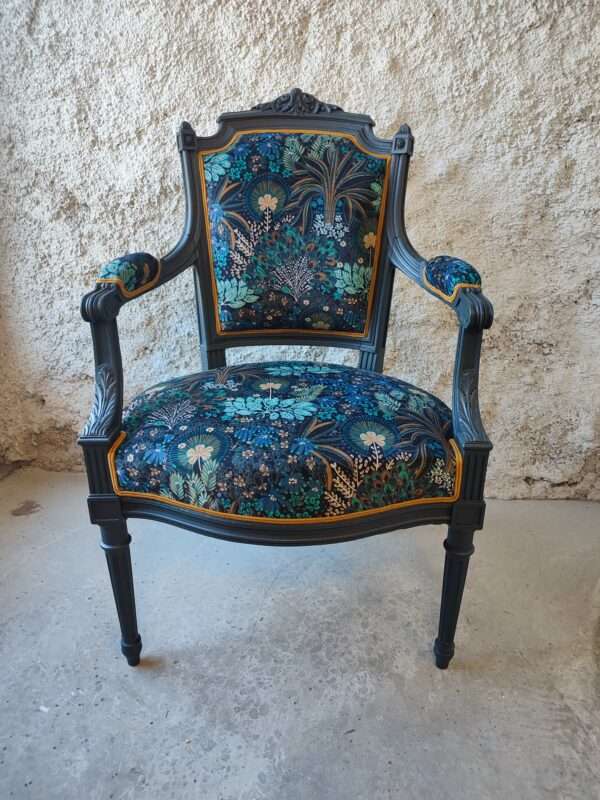
If there’s one chair that comes through the workshop more than any other, it’s the cabriolet. This elegant little armchair, with its curved backrest and tapered legs, is one of the most common antique chair styles you’ll find in France and beyond. It turns up everywhere: at flea markets, in family attics, in Parisian apartments, in countryside homes. And people bring it to me constantly.
The cabriolet is one of those chairs that never really goes out of style. There’s a reason I see so many of them at the workshop.
What is a cabriolet chair?
A cabriolet chair is a French armchair style that became popular in the 18th century. It’s defined by its curved, outward-facing back, cabriole legs, and compact proportions. The frame is always exposed, which means the upholstery work is visible on all sides and the finish has to be clean all the way around. It’s a small chair, but it has a lot of presence.
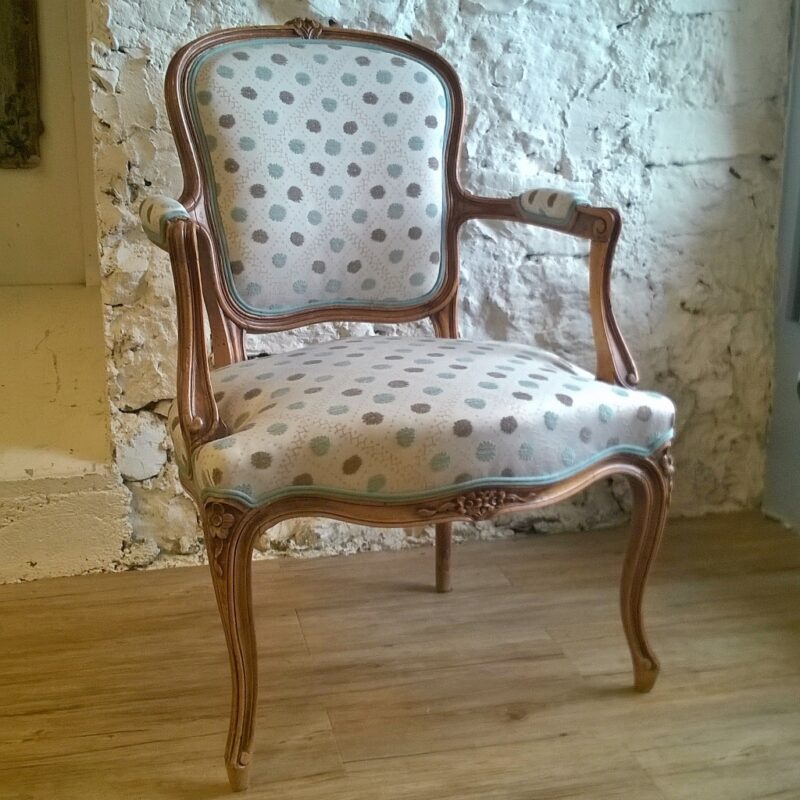
The name itself comes from the French word for a light, bouncy carriage, and there’s something in that: the chair has a certain lightness to it, a gracefulness that heavier armchairs don’t. It was designed to be moved around a room easily, pulled into conversation, placed by a window. It was a social chair, made for people who entertained.
Cabriolet vs. bergère: what’s the difference?
This is one of the questions I get most often, and it’s a fair one because both chairs are French, both are from roughly the same era, and both turn up constantly at antique markets. The difference comes down to two things: the sides and the upholstery.
A bergère has fully upholstered sides, closing in the space between the armrest and the seat. It feels enclosed, generous, almost like a small cocoon. A cabriolet, by contrast, is open on the sides. The armrests are exposed wood, and there’s visible space between the seat and the arms. It feels lighter, more architectural. A bergère invites you to sink in. A cabriolet invites you to sit up straight and look elegant doing it.
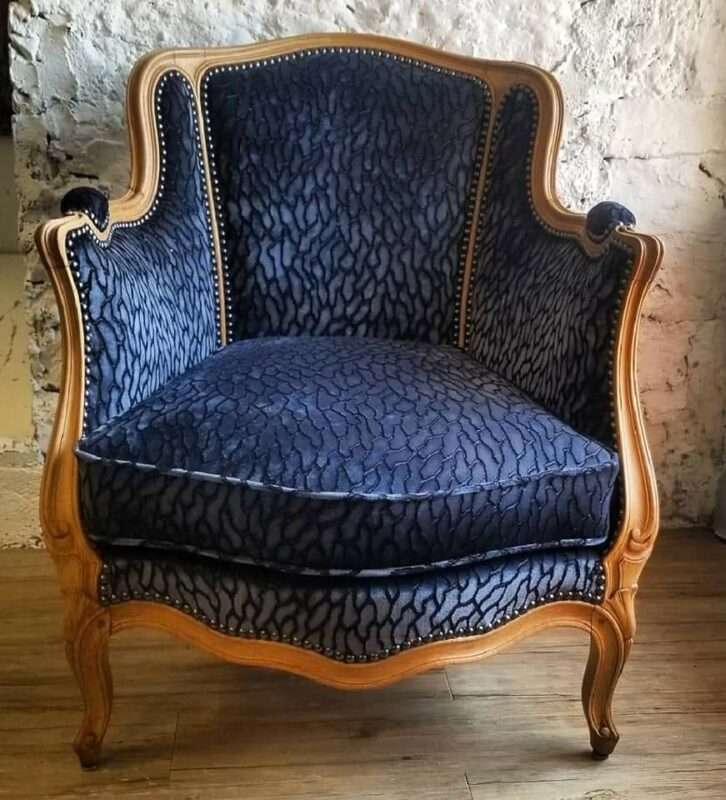
The other key difference is scale. Bergères tend to be deeper and wider. Cabriolets are compact by design. If you’re working with a smaller room or want a chair that doesn’t dominate a space, the cabriolet wins every time.
The main styles of cabriolet chair
Not all cabriolet chairs look the same. The silhouette is consistent, but the back shape, leg style, and period details vary quite a bit depending on when and where the chair was made. Here are the versions you’ll encounter most often.
The round-back cabriolet
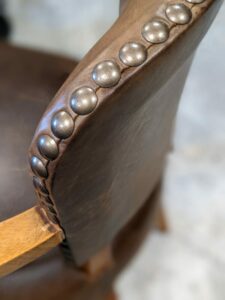
This is the version most people picture when they hear the word cabriolet. The back is oval or medallion-shaped, fully upholstered, and sits slightly tilted for comfort. It’s associated with the Louis XVI period and has a refined, almost jewel-like quality. The round back is often trimmed with nailhead or gimp, which makes the upholstery work particularly satisfying to finish.
The cartouche-back cabriolet
Slightly more ornate, the cartouche back has a curved, shield-like shape that tapers at the bottom. It’s more common in Louis XV pieces and has a softer, more romantic feel than the strict oval. The curves are more pronounced throughout the frame, and the legs often have more elaborate carving.
The flat or rectangular-back cabriolet
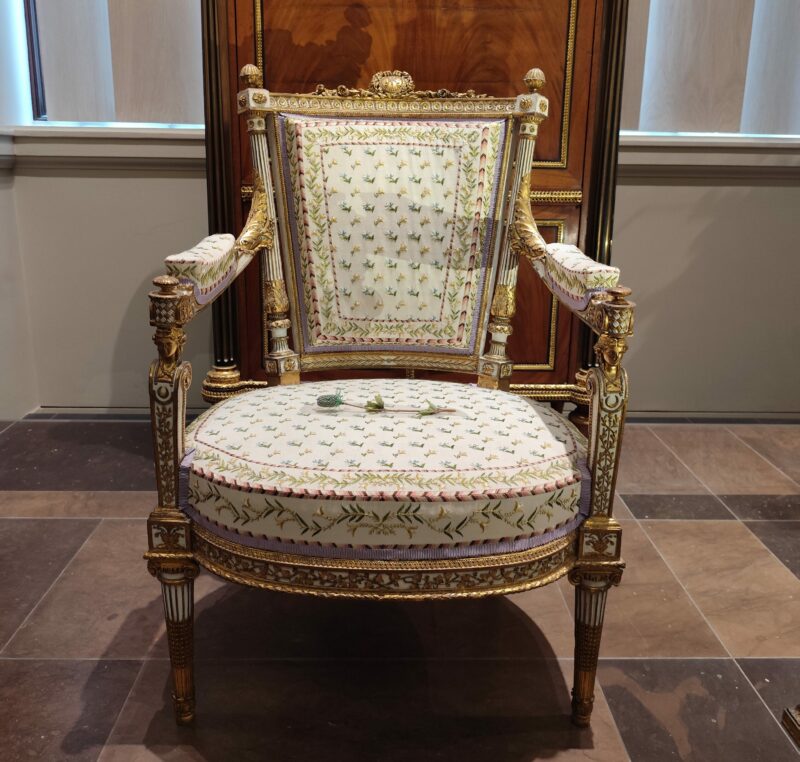
Less common but worth knowing: some cabriolet chairs, particularly from the Directoire or early Empire periods, have a flatter, more geometric back. The lines are straighter, the ornamentation is minimal, and the overall look is closer to neoclassical. These chairs tend to be underestimated at markets, which means they’re often a good find.
The looks you can give a cabriolet chair
This is where the cabriolet really earns its reputation as one of the most versatile chairs to reupholster. The frame is classic, but what you do with the fabric, the finish, and the trim can take it in almost any direction. Here are the main aesthetics people go for.
Classic French, period-accurate
Silk or silk-effect fabric in dusty rose, sage, or ivory. Nailhead trim following the frame line. The wood painted in grey or left in natural walnut. This is the approach for a chair that belongs in a Haussmann apartment or a carefully curated antique interior. It’s faithful to the period and it’s beautiful done well.
Contemporary contrast
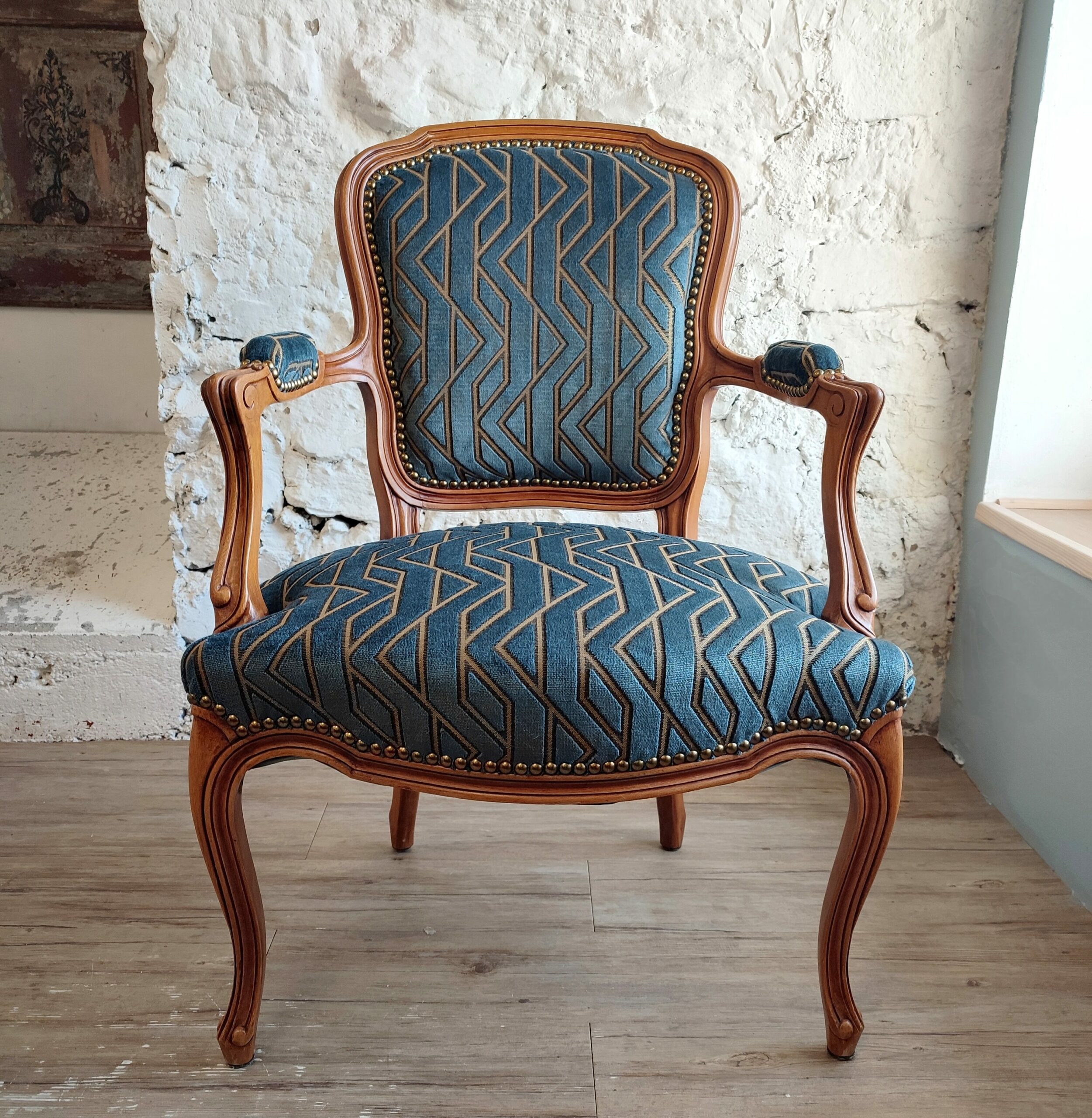
A boucle, a bold graphic print, or a flat-weave linen in an unexpected color. The wood painted in black, forest green, or deep navy. This is the approach that makes people stop and ask where you found the chair. The contrast between the antique frame and the modern fabric is the whole point, and when it works, it really works.
Quiet and natural
Undyed linen, raw cotton, or a textured neutral. The wood left as-is or lightly waxed. No trim, or a simple cotton double cord. This is the Scandinavian-meets-French-countryside approach, and it suits the cabriolet surprisingly well. The simplicity lets the chair’s shape do all the talking.
Maximalist and unapologetic
Velvet in a saturated color: terracotta, cobalt, bottle green, deep plum. Gimp or contrasting nailhead trim. The wood gilded or painted in a complementary tone. This is the approach for someone who wants the chair to be the focal point of the room. It takes confidence, but it’s incredibly rewarding.
Toile de Jouy, the classic French countryside look
Toile de Jouy on a cabriolet is almost a cliché at this point, but it’s a cliché for a reason. The pastoral scenes on a cream or blush background, the wood in white or soft grey: it’s a combination that has worked for 250 years and will keep working. If you’re restoring a chair for a traditional interior, this is the safe choice in the best sense of the word.
Graphic and editorial
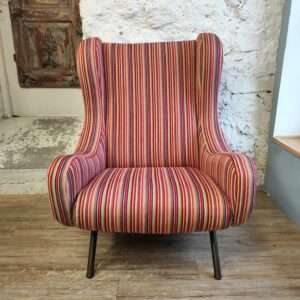
A bold stripe, a geometric print, or a large-scale botanical pattern cut carefully to center on the back and seat. Black-painted wood. No trim. This is the approach for a design-forward interior, and it suits the cabriolet’s compact proportions well because the frame acts as a natural border around the fabric.
Why the cabriolet is a great first project
It has a reputation for being a beginner-friendly chair, and that’s largely true, but it’s worth being precise about what that means. The structure is logical and consistent. There are no surprising angles, no overly complex internal mechanisms. The sequence of work follows a clear order, and because the chair is small, each step is manageable.
That said, the exposed frame means there’s nowhere to hide. The cut lines have to be clean, the fabric has to be well-tensioned, and the trim work has to be done with care. It’s a forgiving project in terms of complexity, but it rewards attention to detail. Which is exactly why it teaches so much.
Ready to reupholster yours?
The full process is documented right here. Whether you want to work through it at home with the online tutorials, or come and do it in person at the workshop in Annecy, everything you need is below.