
| Project | Seat |
| Piece | Bergère chair |
| Style | Louis XV, Louis XVI and later reproductions |
| Technique | Both |
| Level | Intermediate |
| Stages covered | Prepare · Webbing · Springs · Padding · Covering · Finishing · Sewing |
| Springs | Optional, simple springing |
| Fabric | 3 to 4 m (3¼ to 4½ yd), 140 cm (54 in) wide |
| Trim | Braid or double piping, 9 to 11 m (10 to 12 yd), or one box of decorative nails |
| Cushion piping | Single piping, about 8 m (8¾ yd) |
| Cushion | Foam, feathers or both |
To reupholster a bergère chair, work in this order: assess the chair, strip and prepare the frame, redo the seat base (webbing, with or without springs), pad the back and sides, cover the chair panel by panel, finish the edges with braid, piping or nails, and make the loose cushion last, fitted to the finished seat. Plan 3 to 4 metres of fabric (140 cm wide) for a standard European bergère.
The bergère is one of the most rewarding French armchairs to restore, and a real step up from a cabriolet or a bridge chair: the cushion involves sewing, the closed sides add panels to cover, and every edge along the wooden frame must be finished cleanly. But the process is logical, and taken one step at a time, it is absolutely achievable. This page gives you the plan, the quantities and the tutorials for every stage.
On this page: Is it a bergère? · Assess your chair · Fabric and materials · Fabric ideas · Step by step · FAQ
First, is your chair a bergère?
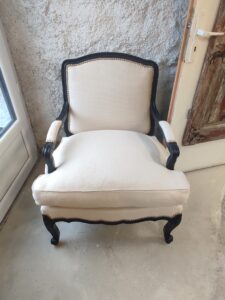
Check the sides. If the space between the armrest and the seat is upholstered and closed in, and the seat has a loose cushion, it is a bergère. If you can see through the sides, it is a cabriolet, and its tutorials are different.
History, styles, the bergère à oreilles and how it differs from a wingback or a club chair: everything is in What is a bergère chair?
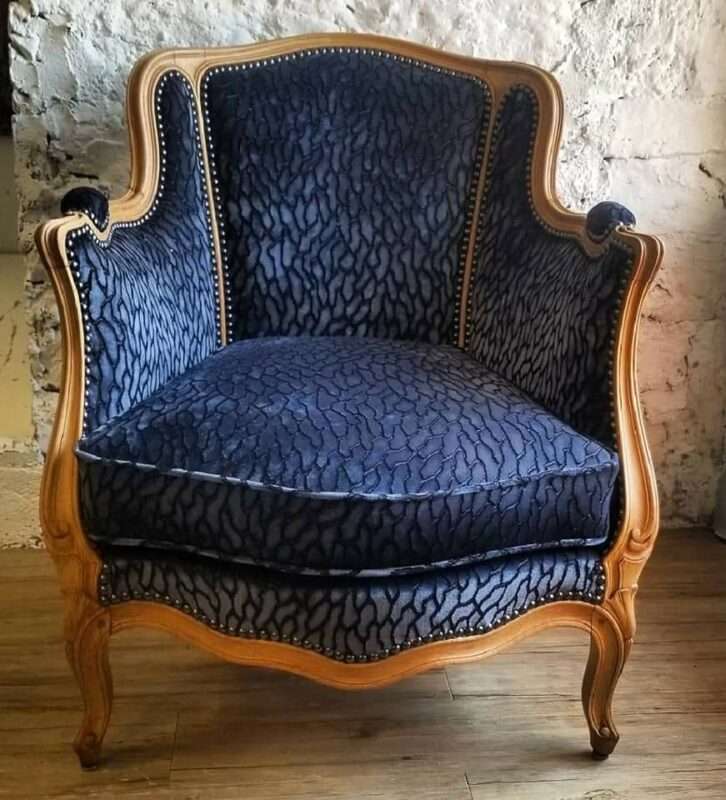
Before you strip anything: assess your chair
This is the step most people skip, and the one they most often regret. Many of my students have stripped the arms of their bergère straight away, only to realise later that the padding was in perfect condition. Before you remove a single tack, go through the chair methodically:
- The seat base: does it sag? Are the springs still working, or is the webbing giving way?
- The back and sides: is the padding still firm and well shaped, or collapsed?
- The cushion: does it just need a new cover, or a new inside too?
- The frame: are the joints solid? Does the wood need repairs or a new finish?
Your answers decide the project: a full restoration, a new seat and cushion, or simply a new cover. Once you know exactly what needs to come off, see preparing a chair frame: stripping, repairing and finishing the wood.
How much fabric and what materials do you need?
Fabric
For a standard European-size bergère, plan for 3 to 4 metres of fabric at 140 cm wide. If your fabric has a large pattern repeat, or if you want to centre a motif on the back and the cushion, allow a little more. For your exact chair, use the free fabric calculator.
Finishing
- Along the wooden frame: a box of decorative nails, or 9 to 11 metres of braid or double piping.
- For the cushion: around 8 metres of single piping for the borders.
- Optional: 3 to 4 metres of single piping around the outside back, and the same on the cushion if you want a contrast.
Single or double piping? The upholstery piping guide explains the difference.
Materials and tools
- Materials: webbing (elastic or jute), springs and twine if you restore a sprung seat, hessian, padding (natural fibres or foam), wadding, calico, and the cushion filling (foam, feathers or both).
- Tools: a staple gun or an upholstery hammer and tacks, a ripping chisel to strip, upholstery scissors, a regulator, curved needles and a sewing machine for the cushion and the piping.
Every tool and material is explained in the upholstery tools guide and the upholstery materials guide.
Fabric choices and upholstery ideas for a bergère
The bergère is one of the most versatile chairs when it comes to fabric. Its large surfaces give you real room to work with pattern and texture, and almost everything works if it is chosen with intention.
- Plain cotton velvet: one of the most reliable choices. It suits the classic silhouette, wears well and looks rich without being fussy.
- Jacquards, damasks and toile de Jouy: a natural match for a period bergère.
- Large-scale prints: the back and the sides give them room to express themselves fully. Centre the motif on the inside back and on the top of the cushion for a tailored look.
- Small repeats: for a more discreet, lived-in result.
Avoid very chunky or loosely woven fabrics: they are harder to tension evenly along the frame and wear quickly on a chair used every day. For a seat, choose at least 30,000 Martindale rubs.
How to reupholster a bergère chair, step by step
Step 1: strip and prepare the frame
Remove only what needs to go, keeping the old cover as a reference for your cuts. Glue loose joints, repair the wood and refresh the finish before any upholstery goes on: once the chair is covered, the frame is much harder to reach. See preparing a chair frame.
Step 2: the seat base, with or without springs
The seat carries the cushion, so it must be solid before anything else goes on. It always starts with webbing; then you choose whether the seat gets springs or not, depending on the chair’s original construction and the comfort you want.
Option 1, without springs: elastic webbing. The simplest and most practical approach, and the best choice for a first bergère. The webbing alone carries the loose cushion.
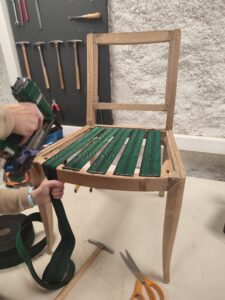
How to web with elastic webbing
Option 2, with springs: traditional webbing and coil springs. If your chair originally had springs and you want to restore it properly, follow these stages in order:
- Webbing: traditional jute webbing on a bergère.
- Positioning the springs: springs positioning tutorial.
- Tying the springs: on a bergère, use the simple springing technique.
- Hessian: cover the springs with hessian and sew them to it.
- Front edge: see how to create a front edge platform.
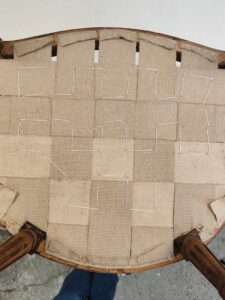
Traditional webbing a bergere chair
Why simple springing? Tying springs is not done the same way on every chair. A cabriolet or a Voltaire has a built-up stuffed seat (garniture à épaisseur), which calls for a different spring-tying technique. A bergère seat is made to carry a loose cushion: here, simple springing is the right method. All the other techniques are in the springs tutorials.
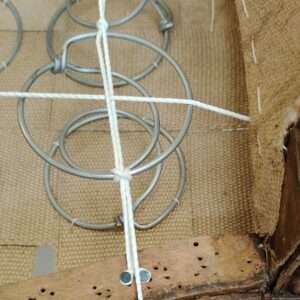
Simple springing technique
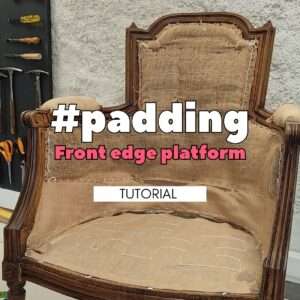
How to create a front edge platform
Step 3: the back and sides
The back is one of the most visible parts of the finished chair: getting its shape right makes everything else look better.
- Keeping the existing padding: if it is still in decent shape but has flattened over time, adding a fresh top layer is often enough.
- Building a new back: if the padding has collapsed or was removed, follow how to upholster the back of a bergère, from the base layer to the final shape. All padding methods, in natural fibres or foam, are in the padding and stuffing tutorials.
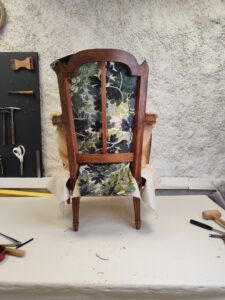
How to upholster the back of a bergere chair
Step 4: covering
Once all the padding is in place, cover the chair panel by panel: the inside back, the inside of the arms and sides, then the outside back and the outside of the sides. The order matters, because each panel hides the fixings of the one before. The outside panels are closed with a hand stitch or with backtacking, the same technique as on the bridge chair back.
- Covering the back of the bergère
- 7 professional tips for a perfect fabric cover
- All covering techniques: backs, arms and corners
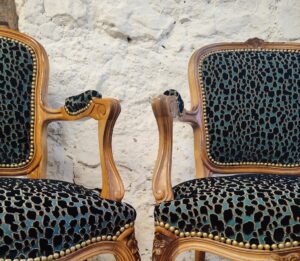
How to cover the arm of a Louis 15 style chair
Step 5: finishing along the frame
On a bergère, the fabric stops against visible wood all around the chair. Braid, double piping or decorative nails hide the staples and give the chair its final line. See the finishing tutorials.
Step 6: the seat cushion
Make the cushion last: its pattern is taken on the finished seat, so it fits the chair exactly. This is where the bergère differs most from simpler chairs: the cover must be cut, piped and sewn before the cushion is filled and closed. Take your time, a well-made cushion is the difference between a professional result and one that looks homemade.
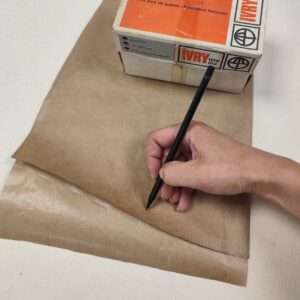
How to Make a Perfect Seat Cushion Pattern for a Bergère Chair
How to stitch a T-cushion
Foam or feathers? A foam cushion is firmer, keeps its shape and is easy to maintain, ideal for a chair used every day. A feather cushion is softer, with that sinking-in feeling that makes a bergère so comfortable, and suits period chairs beautifully; its inner cover must be tightly sewn so the feathers stay in.
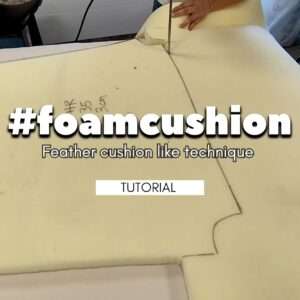
How to create a feather like FOAM cushion
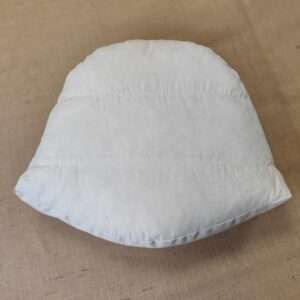
How to create a feather seat cushion
Is the bergère right for you as a beginner?
The bergère is not the most complex project out there, but it is a step up from a simple dining chair or a bridge chair. If you have already done one of those, you are ready. If this is your very first project, start with a simpler seat from Guide 1: the skills carry over directly, and you will tackle your bergère with much more confidence.
Reupholstering a bergère: frequently asked questions
How much fabric do I need to reupholster a bergère?
3 to 4 metres at 140 cm wide for a standard European bergère, plus 9 to 11 metres of braid or double piping (or a box of decorative nails) and about 8 metres of single piping for the cushion.
In what order do you reupholster a bergère?
Frame, seat base, back and sides padding, covering, finishing, and the cushion last, so that it fits the finished seat.
Can I just change the cover and keep the padding?
Yes, if the padding is still firm and well shaped. Strip only the fabric, add a fresh layer of wadding if needed, and cover. This is the most accessible way to start with a bergère.
Do I need springs in a bergère seat?
No. Elastic webbing under a good cushion gives a comfortable, simpler seat. If the chair had springs, restoring them keeps it authentic: on a bergère, they are tied with the simple springing technique, not the method used for the stuffed seat of a cabriolet or a Voltaire.
Do I need a sewing machine?
Yes, for the cushion cover and the piping. See the perfect sewing machine for upholstery work.
Questions about your own chair? Write to me, or join the Hammer Club below.
Written by Céline Vanier, upholsterer trained with the Compagnons du Devoir, working in her atelier near Lake Annecy, France, since 2012.
Learn upholstery in three steps
Start with a simple project, learn the techniques behind every seat, then take on complete chairs.
Guide 1
Beginners
Simple, forgiving projects that teach the basics: cushions, seats and easy chairs. Ideal if you have never upholstered before.
Start with Guide 1Guide 2
Techniques
The steps professionals use every day: prepare, webbing, springs, padding, covering, finishing and sewing.
Explore the techniquesGuide 3
Projects
Complete projects from frame to finished piece: stools, cushions, headboards, chairs and armchairs.
See the projects