
Fabric is the part of a chair everyone sees, and too often the part chosen last, in a hurry. It deserves better. The right upholstery fabric makes a seat last for decades. The wrong one stretches, puckers, fades or wears through in a couple of years, however good the work underneath. This guide covers what makes a fabric suitable for upholstery, how to read its technical label, the main fibers and weaves, and the fabric houses worth knowing.
Everything here comes from daily work in my atelier by Lake Annecy, covering seats for clients and teaching the craft.
What Makes a Fabric an Upholstery Fabric
An upholstery fabric is woven tight and heavy enough to be pulled hard over padding without distorting, gaping at the seams or letting the stuffing show through. It holds tacks and staples without tearing and keeps its shape once tensioned.
Curtain and dressmaking fabrics are usually too light and too loose for a seat. They can work on a headboard, a screen or a decorative back nobody leans on, but not where people sit every day.
Abrasion Resistance: What the Martindale Numbers Really Mean
The first figure to check is abrasion resistance. In Europe it is given in Martindale cycles: a sample is rubbed against a standard abrasive cloth in a looping, figure-of-eight movement until it shows wear. In the United States you will more often see the Wyzenbeek test, given in double rubs. Either way, the higher the number, the more friction the fabric can take.
| Martindale cycles | Typical use (industry guide) |
|---|---|
| Under 10,000 | Decorative only: cushions, headboards |
| 10,000 to 15,000 | Light domestic use: occasional chairs |
| 15,000 to 25,000 | General domestic use: dining chairs, armchairs |
| 25,000 to 40,000 | Heavy domestic use: everyday sofas, family chairs |
| Over 40,000 | Contract use: hotels, restaurants, offices |
That is the industry guide. My own rule for a seat in everyday domestic use is at least 30,000 cycles.
Here is what nobody tells you: these numbers are not always comparable. Depending on the manufacturer and the country it comes from, the test is not run or read with the same strictness, and the point at which a fabric is considered worn varies. In practice, 30,000 cycles announced by a demanding house like Pierre Frey can be worth more than 100,000 cycles announced by another brand. So read the figure, but trust the fabric house as much as the number, and always judge the density and the hand of the fabric yourself.
Abrasion is not the whole story either. Check pilling resistance and light fastness too, especially for a chair that sits near a window.
Natural, Synthetic or Blended Fibers
Natural fibers are the traditional choice. Linen is strong and matte, and creases with character. Cotton is easy to work and takes color beautifully. Wool is resilient, naturally fire resistant and ages well. Mohair gives the densest, longest lasting velvets. Silk is magnificent and fragile: keep it for pieces that are admired more than used.
Synthetics such as polyester, acrylic and polypropylene bring strength, stain resistance and color stability. They are the base of most performance and outdoor fabrics.
Blends are often the best compromise: the look and hand of a natural fiber with the resistance of a synthetic. Viscose sits somewhere in between, soft and lustrous but sensitive to water marks.
The Main Types of Upholstery Fabric
Upholstery fabrics are also defined by their weave, and the weave changes everything: how the fabric feels, how it reflects light, and how it behaves on a curve.
Plain Weaves and Twills
Canvas, plain linens and twills are the easiest fabrics to start with. They are stable, readable and forgiving, which makes them ideal for a first chair.
Velvets
Cotton, mohair, silk or synthetic, velvet has a pile, so it has a direction. Its color changes depending on the way the pile runs, and every panel of the chair must follow the same direction. Crushed, embossed and ribbed velvets each behave differently on a seat.
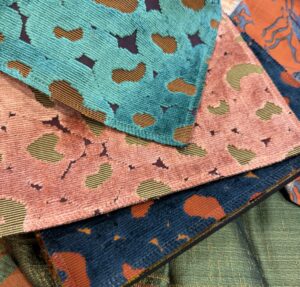
What is velvet Fabric? An Upholsterer’s Guide to Velvet
Jacquards, Damasks and Lampas
The pattern is woven into the fabric rather than printed on it. These are the traditional fabrics of French period seats, from Louis XV to Napoleon III. They are rich, structured and often heavy, and their motif has to be centered on the seat and the back.
Bouclé and Chenille
Textured, soft and very popular on modern shapes. Bouclé is made of looped yarns, chenille of a fuzzy yarn that catches the light. Both are lovely to touch, but their resistance varies a lot from one quality to another, so check the figures before choosing.
Printed Fabrics and Toile de Jouy
Printed cottons and linens, including the famous toile de Jouy, bring pattern at a lighter weight. The print sits on the surface, so the quality of the base cloth matters as much as the design.
Leather and Faux Leather
Not strictly a fabric, but a classic covering for office chairs, club chairs and dining seats. Leather is sold by the hide, not off the roll, and it is worked differently from woven fabric.
How to Read an Upholstery Fabric Label
Every fabric house gives the same basic information, and learning to read it saves a lot of disappointment. The width tells you how much fabric you get across the roll, usually around 140 cm (54 in) for upholstery. The repeat gives the height and width of the pattern, which decides how much fabric you lose when you match it. The composition lists the fibers, and the abrasion figure tells you how much wear the fabric can take. You will also find cleaning instructions, light fastness and fire ratings. Fire rules vary by country and by use: a home, a hotel and a public space do not follow the same standards.
Direction matters too. Some fabrics can be railroaded, turned sideways on the chair, which saves fabric on a wide seat or a sofa and avoids seams. Others cannot, because of their pile or their pattern. All these words are explained in the Upholstery Glossary, in English and French.
Choosing the Right Fabric for Your Seat
The right fabric depends on the chair, its style, the way it will be used and the technique underneath. A Louis XVI bergère, a dining chair used three times a day and a mid-century armchair do not call for the same cloth. Before you fall for a color, ask yourself who sits there, how often, in what light, and whether the fabric will follow the shapes of the frame.
I go through all these questions, one by one, in What Type of Upholstery Fabric Should You Choose to Cover a Seat?, available to members.
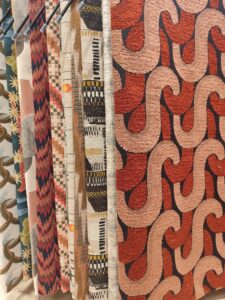
What Type of Upholstery Fabric Should You Choose to Cover a Seat?
From Fabric to Finished Seat: Covering
A good fabric only shows its quality once it is on the chair, and that is where covering comes in. This is the stage where the fabric is cut, positioned and tensioned over the padding, then fixed to the frame. The grain has to run straight, the pattern has to sit in the center of the seat and the back, the pile of a velvet has to run the same way on every panel, and the tension has to be even so the fabric holds without wrinkles or pulls. Corners, curves and rails each ask for their own cuts and folds.
Each fabric reacts differently: a stiff jacquard does not fold like a soft linen, and a bouclé does not forgive the same mistakes as a canvas. The Covering Tutorials walk you through every step on real chairs, from the first cut to the last fixing.
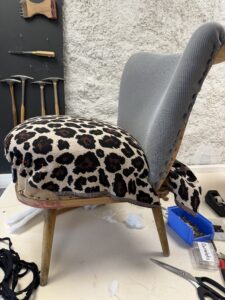
Upholstery techniques tutorials for COVERING
Designer Fabrics and Fabric Houses
Fabric houses design and publish collections, then sell them through upholsterers, decorators and showrooms. French houses in particular have a long tradition of upholstery fabrics, from historical reproductions to very contemporary designs. Buying from a good house gives you consistent quality, reliable technical data and a color that stays the same from one order to the next.
After fifteen years at the bench, I have my favorites, and I explain why in My Favorite Fabric Brands. And if you like looking at fabric as much as I do, the Fabrics section is where I share the collections I am currently eyeing.
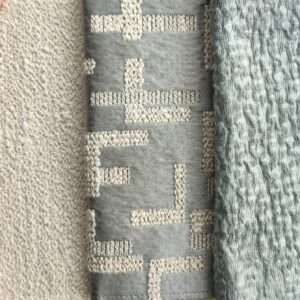
My favorite fabrics brands
Upholstery Fabric: Frequently Asked Questions
How much fabric do I need for a chair?
The amount of fabric required depends on the chair’s size, shape, and design. A standard dining chair usually needs around 1 to 1½ yards of upholstery fabric, while a larger armchair may require 5 to 7 yards. Chairs with deep cushions, pleats, matching patterns, or separate back and seat panels may need extra fabric.
Before buying, measure each upholstered section carefully and add enough material for seams, pattern matching, and wrapping the fabric around the edges. It’s also a good idea to purchase an additional 10–15% to allow for mistakes or adjustments.
For a more accurate estimate, use our free fabric calculator. Simply enter your chair’s measurements to calculate how much upholstery fabric you need for your project.
Can I use any fabric to reupholster a chair?
You can, but you should not. A fabric that is too thin, too loose or too weak on abrasion will stretch, show the stuffing underneath and wear out quickly. Always check that the fabric is sold for upholstery.
What is the most durable upholstery fabric?
Durability depends more on the weave and the density than on the fiber alone. Tightly woven fabrics with a high abrasion score, mohair velvet, good wool and quality blends are among the most hard-wearing.
How many Martindale cycles do I need for a chair?
For everyday domestic use, aim for at least 30,000 cycles. Keep in mind that figures are not measured the same way by every manufacturer, so a high number from an unknown brand does not always mean a more durable fabric than a lower one from a serious fabric house.
What is the best fabric for a beginner?
A plain, medium-weight fabric without a pattern or a pile. It lets you focus on tension and corners without worrying about matching a motif or the direction of a velvet.
Should I order a sample first?
Always. Colors change from a screen to real light, and only the fabric in your hands tells you its weight, its hand and how it drapes over an edge.
Go Further
Fabric is only the visible layer. The Upholstery Materials guide covers everything that goes underneath, and the Upholstery Tools guide everything you need on your bench. To access all the tutorials and members-only articles, join the membership.