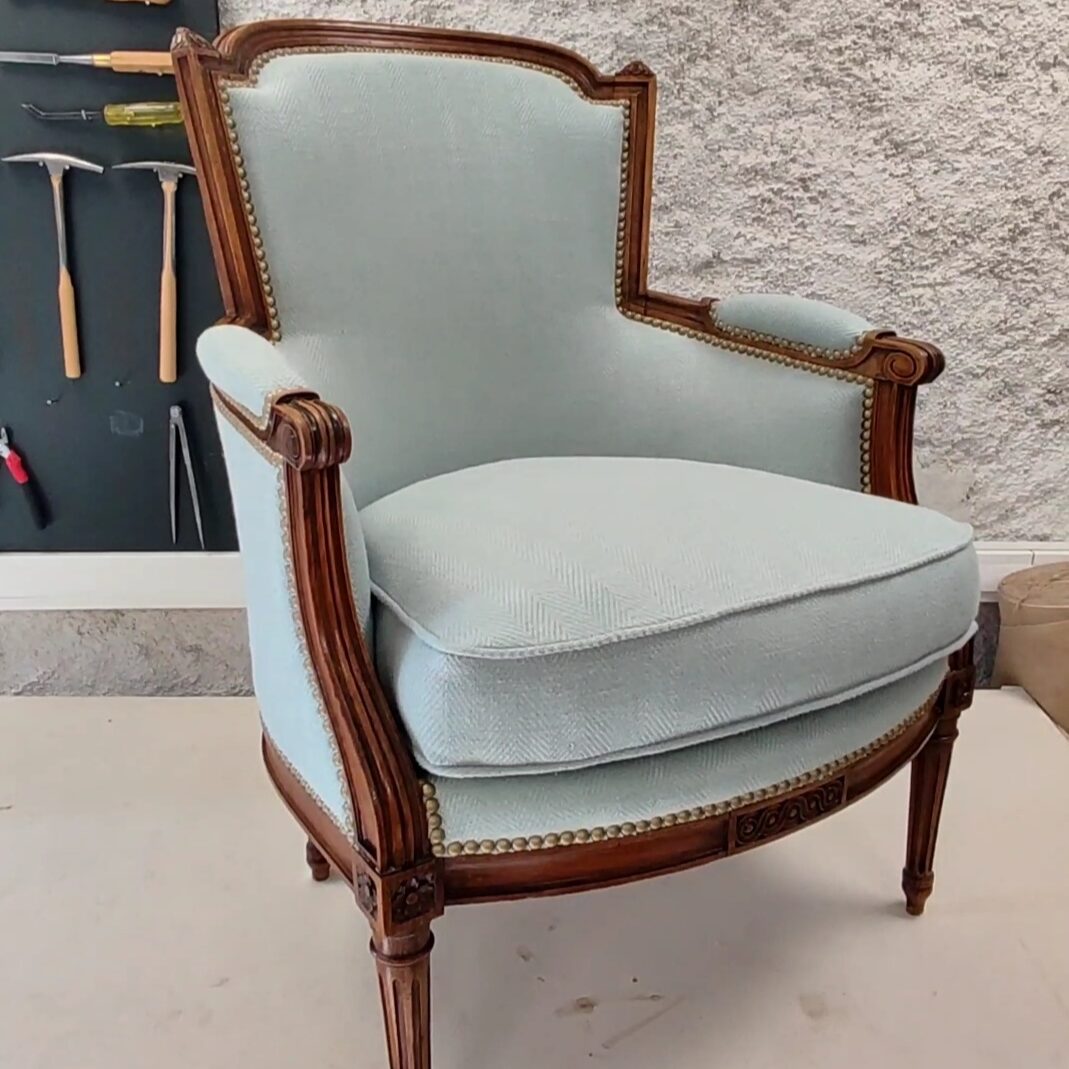
A bergère is a French armchair with a visible wooden frame, closed upholstered sides, a wide, deep seat and a loose cushion. It was born in 18th-century France, under Louis XV, as a chair made for comfort rather than ceremony. The space between the arm and the seat is fully upholstered: this is the detail that sets it apart from an open armchair such as the cabriolet.
On this page, you will find everything to understand and recognise a bergère chair: where it comes from, how to tell it apart from a cabriolet, a wingback or a club chair, its main styles and what is hidden inside. Ready to work on one? The complete bergère tutorial guide gives you the fabric quantities, the tools and every step in order.
On this page: History · How to recognise it · Bergère, cabriolet, wingback or club? · Styles and variants · What is inside · Is it a good first project? · FAQ
Where does the bergère come from?
The bergère appeared in France in the first half of the 18th century, when the court of Louis XV turned away from the stiff, formal seats of the previous reign. Salons became smaller and more intimate, and people wanted chairs to sink into, to read, talk or rest by the fire.
“Bergère” means shepherdess in French, a nod to the taste of the time for an idealised country life. The name stayed, and the chair never really went out of fashion: every period since has produced its own version, and the bergère is still one of the most loved French armchairs today.
Want to see period bergères come back to life in my workshop? Read Louis XV bergères in blue velvet and a Louis XVI bergère in Manuel Canovas in the Journal.
How to recognise a bergère chair
- Closed sides: the space under the arm, between the armrest and the seat, is upholstered. This is the number one test.
- A loose seat cushion in most cases, resting on a sprung or webbed seat.
- A wide, deep seat, often slightly reclined: you sit in a bergère, not on it.
- A visible wooden frame, carved, painted, gilded or simply waxed, around the back, the arms and the legs.
- Short, padded armrests (the manchettes) on top of the closed sides.
All the armchairs below are bergères, from different periods and styles. Sizes and shapes vary, but the concept stays the same.


Bergère, cabriolet, wingback or club chair?
These armchairs are confused all the time, online and in shops. Here is how to tell them apart.
Bergère vs cabriolet
A cabriolet chair is open under the arms: you can see through the sides, and the seat is usually fixed. A bergère is closed on the sides and has a loose cushion. A bergère invites you to sink in; a cabriolet invites you to sit up straight.
Where it gets confusing: in French, “cabriolet” also describes the shape of the back, curved inward to follow the body, as opposed to a flat back, called “à la reine”. So a bergère can have a cabriolet back: it is then called a bergère en cabriolet, and it is still a bergère, because its sides are closed.
Bergère vs wingback chair
A wingback has “wings” on each side of the back, at head height, originally to protect from draughts. The French version is the bergère à oreilles, literally a bergère with ears: a bergère with a visible frame and wings. An English wingback, on the other hand, usually hides its frame entirely under the upholstery.
Bergère vs club chair
Both are deep, comfortable and have a loose cushion. The difference is the wood: a bergère shows its frame, a club chair hides it completely under padding and leather or fabric.
Not sure what you have? The different types of chairs helps you identify the most common ones.
The main styles and variants of bergère
Louis XV bergère
All in curves: a rounded back, curved arms, cabriole legs and carving inspired by flowers and shells. This is the original bergère, and the one most people picture.
Louis XVI bergère
Straighter and more architectural: square or medallion-shaped back, straight tapered legs, often fluted, and finer, more regular carving.
19th-century and modern bergères
Directoire, Empire, Restauration, Napoleon III: every period after the 18th century made its own bergères, more severe or more padded depending on the taste of the time. Many bergères found today are later reproductions of Louis XV and Louis XVI models, and they are just as good to upholster.
Variants worth knowing
- Bergère à oreilles: with wings on each side of the back, the French wingback.
- Bergère gondole: the back curves round continuously into the arms, like the stern of a gondola.
- Bergère marquise: a wider bergère, with room to spread out.
- Cane bergère: the back and sides are caned instead of upholstered. Only the cushion is upholstery work.
- Bergère with ottoman: paired with a matching footstool. When the two pieces join to form a chaise longue, it is called a duchesse brisée.
What is inside a bergère?
Under the cover, a bergère is made of three parts, and each one can be kept or redone separately:
- The seat base, which carries the cushion: either traditional webbing with coil springs, or a simpler elastic webbing.
- The loose cushion, filled with feathers, foam, or foam wrapped in feathers.
- The back and sides, padded with natural fibres on period chairs, or foam on more recent ones.
This is good news: a bergère whose back is in good condition may only need a new seat, a new cushion and a new cover. Check every part before you strip anything. The bergère tutorial guide walks you through each option.
Is a bergère a good first upholstery project?
Honestly, not as a very first one. A bergère means a sprung seat, a sewn cushion, closed sides and a lot of covering around a visible frame, where every staple has to be hidden. It is a beautiful second or third project.
If you are a beginner, start with a stool or a simple chair from Guide 1. You will learn webbing, padding and covering on a small surface, and your bergère will thank you for it.
Already have a bergère waiting? It can still be your project: if the back and the seat are sound and it only needs a new cover and cushion, it is within reach of a motivated beginner.
Bergère chair: frequently asked questions
What does bergère mean, and how do you pronounce it?
Bergère is French for shepherdess. It is pronounced “bair-ZHAIR”, with a soft “g” like the “s” in “measure”.
What is the difference between a bergère and a fauteuil?
“Fauteuil” simply means armchair in French. In furniture vocabulary, it usually refers to an armchair with open sides, like the cabriolet, while the bergère has closed sides and a loose cushion.
Is a bergère chair comfortable?
Very: it was designed for that. The deep seat, the closed sides and the loose cushion make it one of the most comfortable French armchairs.
Can a bergère look modern?
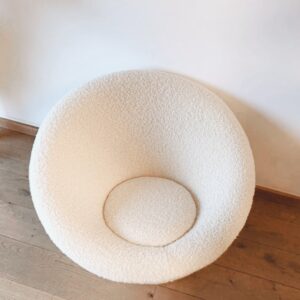
Absolutely. A painted frame, a plain bouclé, a bold velvet or a large-scale print can turn a classic bergère into a very contemporary piece. The upholstery fabric guide helps you choose.
How much fabric do I need for a bergère?
The quantities, with the piping and trimmings, are in the bergère tutorial guide. For your exact chair, use the free fabric calculator.
Written by Céline Vanier, upholsterer trained with the Compagnons du Devoir, working in her atelier near Lake Annecy, France, since 2012.
Keep exploring
- How to reupholster a bergère chair: the complete tutorial guide.
- How to make a perfect seat cushion pattern for a bergère.
- Cabriolet chair tutorials: the open-sided cousin.
- What is a club chair?: the other great armchair with a loose cushion.
- Guide 3: Full upholstery projects: all the chairs and projects.
Learn upholstery in three steps
Start with a simple project, learn the techniques behind every seat, then take on complete chairs.
Guide 1
Beginners
Simple, forgiving projects that teach the basics: cushions, seats and easy chairs. Ideal if you have never upholstered before.
Start with Guide 1Guide 2
Techniques
The steps professionals use every day: prepare, webbing, springs, padding, covering, finishing and sewing.
Explore the techniquesGuide 3
Projects
Complete projects from frame to finished piece: stools, cushions, headboards, chairs and armchairs.
See the projectsAll of these techniques, and many more, are available in full detail inside the Hammer Club. Every tutorial is filmed step by step in my workshop, on real pieces, so you can follow along at your own pace, pause, rewind, and come back whenever you need a refresher.