
Do you really need an overlocker for upholstery?
Not for everything. For a fixed cover attached to a chair, or piping sewn straight onto a seat, you can do without one. For cushions and cushion piping, it’s essential: it gives an even piping flange and clean inside seams that go through the washing machine.
Members often ask me this when they start sewing their first cushions. Here is how I use an overlocker in my workshop, when it really matters, and which machines are worth looking at if you need one that goes from fine fabrics to thick velvets. If you are still choosing your main machine, start with my guide to the perfect sewing machine for upholstery work: the overlocker comes second.
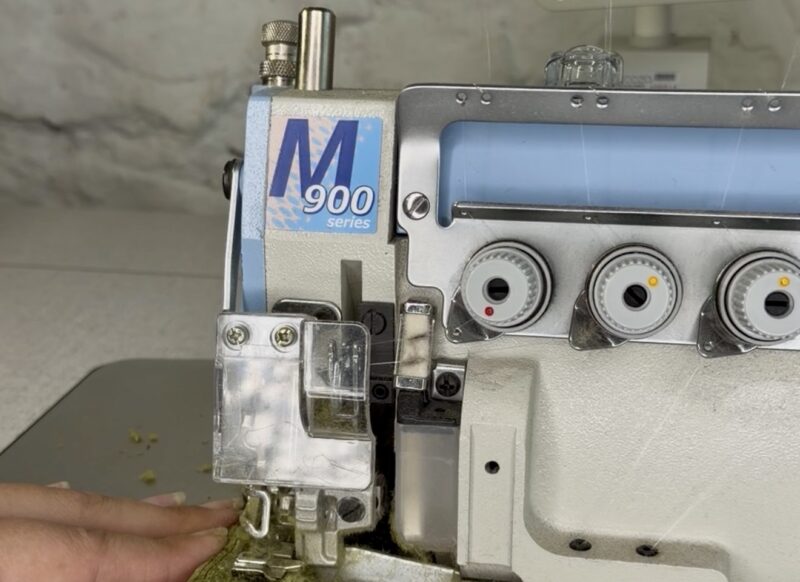
What is an overlocker?
An overlocker, also called a serger, is a sewing machine that trims the raw edge of the fabric with a built-in knife and wraps it in thread in the same pass. Instead of a bobbin, it works with loopers, which carry the threads around the edge of the fabric. The result is an edge that can’t fray, with a regular width from one end of the seam to the other. In French workshops it’s called a surjeteuse. For other trade terms, see my upholstery glossary in English and French.
What does an overlocker do in upholstery?
In my workshop it does two things, and both are about precision.
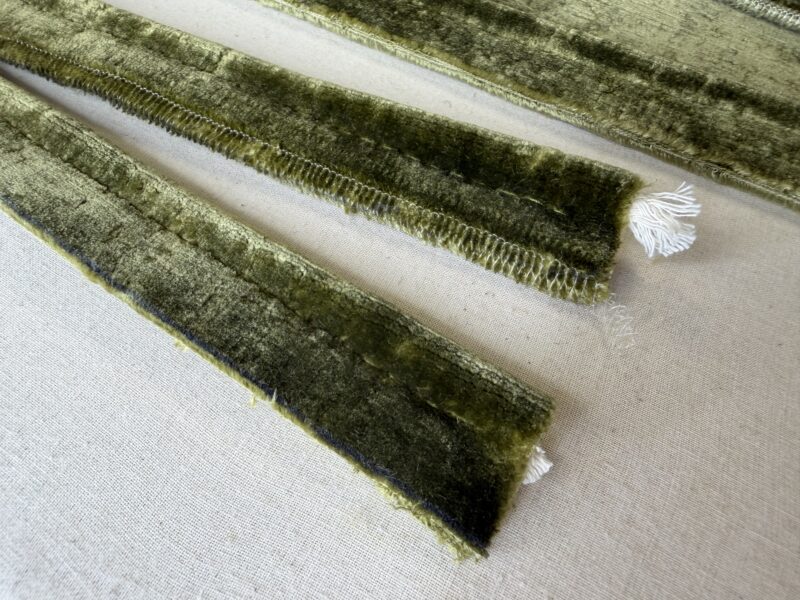
The first is piping. Once the piping is sewn (see how to make upholstery piping, step by step), I run it through the overlocker: the knife trims the flange to an even width. My upholstery piping guide covers piping in more detail, and you’ll find more in the power of piping.
The second is the inside of cushion covers. Every seam is overlocked, so the inside is as clean as the outside, and my clients can put their covers in the washing machine without the seams fraying.
When is an overlocker essential?
For cushions, and for the piping that goes on them. A removable cover is made to be taken off and washed, so its seams have to be finished. In my workshop, that applies to every cushion I sew: a simple cushion cover, a decorative cushion with a piping cord, a bench boxed cushion or a T-cushion. The same goes for the cushions that sit on a chair, like a feather seat cushion or a 3-layer foam seat cushion, and for loose covers (see my 5 pro sewing tips for loose covers).
When can you do without one?
A fixed cover attached to the chair, not meant to come off, doesn’t need it: the seams are hidden inside the upholstery and never washed. The same goes for piping sewn directly onto a seat, as in how to start attaching piping or finishing a round stool with a simple piping.
So if you are starting with fixed covers, like a drop-in seat, one of my stool tutorials or the projects in my covering tutorials and finishing tutorials, you don’t need to buy one yet.
Which overlocker do I use in my workshop?
An industrial 4-thread Pegasus M900.
3, 4 or 5 threads: which one do you need?
A 3-thread overlocker uses one needle and finishes edges. A 4-thread uses two needles: the second needle line reinforces the seam inside the overlock, and it’s the type I use. A 5-thread adds a separate chain stitch, called a safety stitch, next to the overlock. It’s mostly used in the fashion industry.
Industrial or domestic overlocker?
At home, a simple domestic overlocker can be enough, mostly because of space. An industrial machine sits on its own table with its motor, and the head of a Juki industrial overlocker alone weighs around 28 kg (62 lb). If space isn’t a problem, go for an industrial one. For the brand, Juki is a guarantee of quality, in domestic as well as industrial models.
What should an upholsterer check before buying an overlocker?
An upholsterer goes from fine fabrics to thick velvets, and piping means several layers under the foot. So check how many layers the machine can take, and look for a differential feed, which adjusts how the fabric is fed to stop it from puckering or stretching. On an industrial machine, also check the subclass, the letters and numbers after the model name: brands make each machine in several versions depending on fabric weight, and some are designed only for light and medium fabrics. You want one for medium to heavy fabrics.
Which overlockers can an upholsterer buy?
Here are machines you’ll find at sewing machine dealers. My own is the Pegasus M900: I haven’t tested the others, so take this as a starting point for your own comparison, and try a machine with your thickest fabric before you buy.
Domestic overlockers for a home workshop
A domestic overlocker is designed for three or four layers of fabric, no more. That’s enough for cushion seams, but piping adds layers, so it’s the limit to keep in mind. The Brother 1034D is a common first overlocker, recommended on soft furnishing forums. Janome makes the My Lock 344D, and the AirThread 2000D, which threads itself with air. The Juki MO-654DE has a knife with its own drive, made to cut light and heavy fabrics. As a price guide, the Juki MO-654DE sells for around $450 in the US, and the Janome My Lock 344D for around €550 in France.
Industrial overlockers
Juki makes several 4-thread models: the MO-6714S, the MO-6814S, which belongs to a series Juki links to the Pegasus M900, and the MO-6714DA, whose semi-dry head protects the fabric from oil stains, which is reassuring on pale or precious fabrics. Pegasus, the brand of my own machine, makes 4-thread models such as the M952. Jack makes the C4 and the E4S: on the E4S, a lever sets the feed dogs for light, medium or heavy fabrics, useful when you go from silk to velvet. Brother industrial overlockers such as the EF4-B531 are sold second-hand.
As a price guide, new and complete with table and motor, a 4-thread industrial overlocker costs around €1,300 to €1,800 at French dealers, and around $2,500 to $2,800 in the US. Second-hand, prices start around €700 excluding VAT in France. My list of upholstery suppliers and my complete guide to upholstery tools will help you equip the rest of your workshop.
Which thread do you use in an overlocker?
Every workshop has its habit. Some always keep a white cotton thread in the machine. Others change the threads for each project to match the fabric colour, but that’s rarer in industrial workshops: changing all the threads on a machine like this is no small job. In my workshop, we always keep a transparent thread, so we never have to change it from one project to the next, whatever the fabric. For the threads and twines used in the rest of the upholstery, see upholstery twine and thread: which one to use for what.
Do you change the seam allowance with an overlocker?
No. With or without the overlocker, I always allow 1.5 cm (⅝ in). My patterns are taken net, and the seam allowance is added when I cut the fabric. To work out how much fabric you need, use my free fabric calculator, and to choose the fabric itself, my upholstery fabric guide.
Frequently asked questions
Do I need an overlocker to start upholstery?
No. You only need one when you make removable cushion covers or cushion piping. To start, follow my upholstery tutorials for beginners.
Can I make cushions without an overlocker?
Not in my workshop. A removable cushion cover gets washed, and its seams have to be overlocked.
Can an overlocker replace my sewing machine?
No. An overlocker doesn’t sew straight seams, so for piping, zips or topstitching, you still need your sewing machine.
Can a domestic overlocker handle upholstery fabric?
Domestic machines are designed for three or four layers of fabric. With thick velvets and piping you reach that limit, so test with your own fabric before you buy.
Which brand of overlocker is best for upholstery?
Juki is a guarantee of quality, in domestic as well as industrial models. In my workshop, it’s a Pegasus. Choose domestic if you’re short on space at home, industrial if you have the room.
Which thread colour should I use in my overlocker?
In my workshop, always a transparent thread, so we never have to rethread the machine for each fabric.
Where to learn to sew cushions and piping?
All my cushion, piping and loose cover tutorials are gathered in my sewing tutorials for upholstery. They are part of the Membership, and if you are wondering how learning from home works, read how to learn upholstery from home.