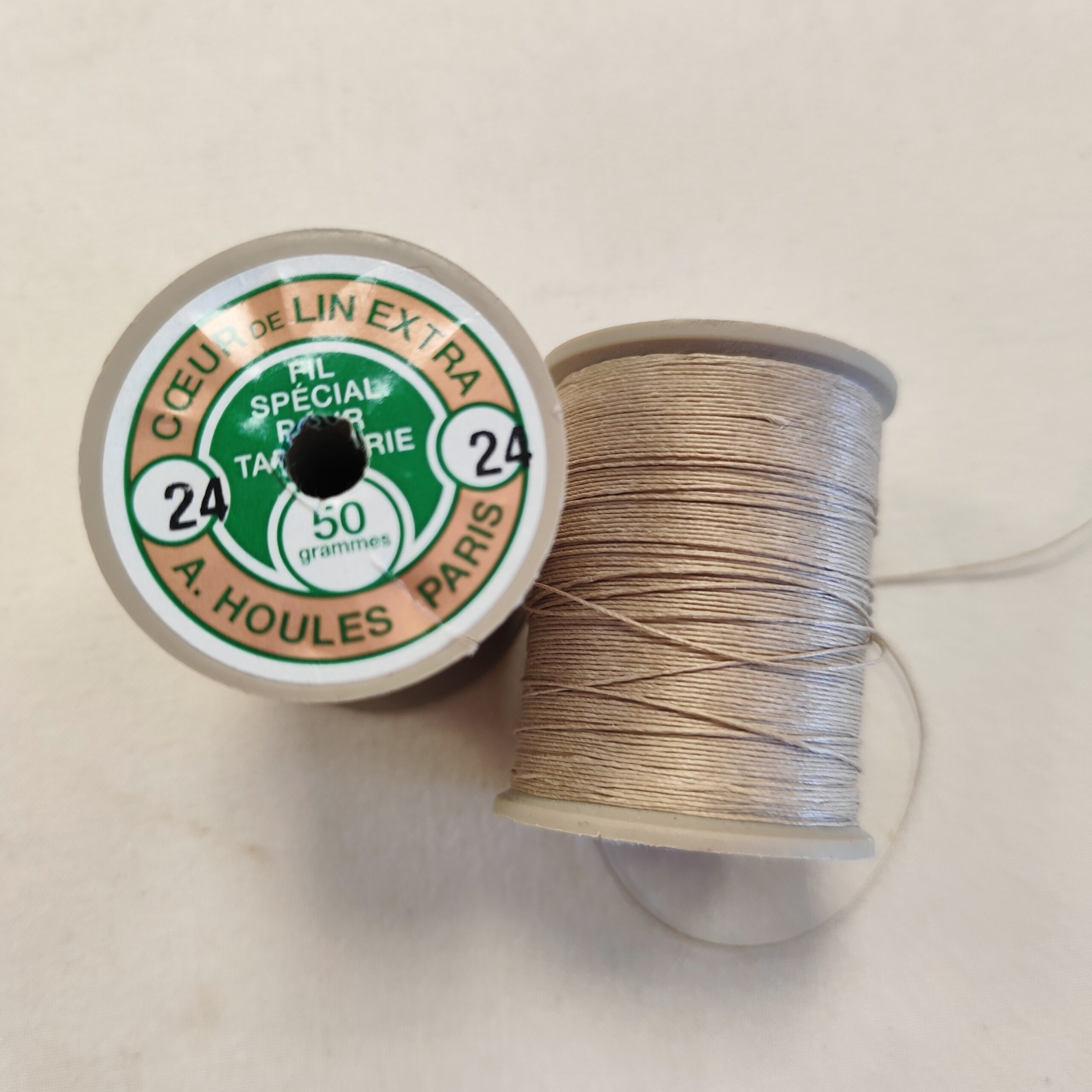
Upholsterers use several kinds of twine and thread, each for a precise job: a thick spring twine to tie the springs, a strong stitching twine to sew springs, laces and edges, a fine linen twine for the blind stitch, a synthetic twine for buttoning, and machine thread for cushions and piping. Using the wrong one is one of the most common reasons a seat sags, a seam slips or a button pulls through.
In my workshop, I keep a whole shelf of twines and threads, and I still reach for different ones on the same chair. Here is what each one is, what it is used for, and how to choose, whether you work in traditional upholstery or in foam.
On this page: Why it matters · At a glance · Spring twine · Stitching twine · Linen twine · Buttoning twine · Machine thread · Linen, cotton or synthetic? · Needles · FAQ
Why does the choice of twine matter so much in upholstery?
In a traditional seat, twine is the structure you don’t see. It holds the springs in place, keeps the stuffing from moving, builds the firm edges and closes the last seams. A seat can have the best horsehair and the most beautiful fabric: if the twine stretches, rots or slips, the whole thing loses its shape within a few years.
Each job asks for a different quality. Tying springs needs a twine that does not stretch. Stitching through stuffing needs one that is strong but slides through the fibres. A blind stitch needs a fine twine that grips and holds the tension between stitches. That is why upholsterers never use “one twine for everything”.
Which twine or thread for which job?
| Twine or thread | French name | Used for |
|---|---|---|
| Spring twine (laid cord) | Ficelle à guinder | Tying the springs |
| Stitching twine | Ficelle à piquer | Sewing springs, laces, stitching through the stuffing, edge stitches |
| Fine linen twine | Ficelle de lin | Blind stitch, hand seams on the cover |
| Buttoning twine | Ficelle à capitonner | Buttons and deep buttoning |
| Machine thread | Fil machine | Cushions, piping, boxed covers |
What is spring twine used for?
Spring twine, or laid cord (ficelle à guinder in French), is the thickest twine in the workshop. It is used for one job: tying the springs (guindage), linking them to each other and to the frame. It has to be very strong and must not stretch, because it sets the height and the shape of the seat for decades. Traditionally it is made of hemp or jute.
A spring twine that stretches is a seat that slowly sinks. It is the one twine you should never replace with something thinner “because it is what you have”. See the simple springing technique and all the springing tutorials.
What is stitching twine (ficelle à piquer)?
Stitching twine (ficelle à piquer) is the workhorse of traditional upholstery. Finer than spring twine but very strong, it is the twine you use the most on a traditional seat:
- to sew the springs to the webbing, then to the hessian;
- to sew the laces (bridle ties) that hold the first stuffing;
- to stitch right through the stuffing, so it keeps its thickness;
- to sew the edge stitches (piqûres) that build the firm, straight edges of the seat.
It has to be strong enough to be pulled hard without breaking, and smooth enough to slide through hessian and fibres. Edge stitching is the step where a weak twine shows first: if it breaks halfway along an edge, you start the row again. These steps are all explained in the 16 steps of traditional French upholstery.
Why use linen twine for the blind stitch?
The blind stitch (point invisible, or point caché) is the hand seam that joins two fabrics edge to edge on the chair itself: closing an outside back, attaching a seat front, sewing a fabric to the one already in place. The stitches must disappear, and the seam must stay tight.
For this, I use a fine linen twine (ficelle de lin). It is the traditional choice for good reasons: linen is very strong for its thickness, it does not slip, so each stitch holds the tension of the one before, and it does not stretch over time. Any thick thread will do the job at a push, but a smooth or stretchy thread lets the seam loosen as you sew, and the fabric gapes. You can see it in use in my tutorial how to cover the seat front of a club chair.
Don’t confuse the blind stitch with top stitching: top stitching is a decorative machine stitch made after an assembly seam, on fabric or leather. The blind stitch is always sewn by hand, on the chair.
Which twine for buttoning?
Buttons and deep buttoning (capitonnage) put a lot of strain on a single point: the twine is pulled tight through the whole thickness of the padding and holds a button under constant tension. A synthetic buttoning twine (nylon or polyester) is often preferred here, because it is very strong, does not rot and does not stretch. A natural twine that weakens with time is how a button ends up hanging loose, or pulled through the fabric.
What thread for sewing cushions and piping?
Everything sewn on the sewing machine, cushion covers, boxed covers, piping, needs a strong thread made for upholstery fabrics, heavier than a dressmaking thread. Seams on a seat are pulled every time someone sits down: a thin thread breaks, and the seam opens along the piping. Choose a thread colour that matches the fabric, as the stitches can show along the piping.
Linen, cotton or synthetic: what is the difference?
| Material | Strengths | Weaknesses | Best for |
|---|---|---|---|
| Linen | Very strong, grips, does not stretch, traditional | More expensive | Blind stitch, hand seams, traditional work |
| Hemp, jute | Strong, does not stretch, natural | Thick, can be rough | Spring tying, stitching twine |
| Cotton | Soft, cheap | Weaker, stretches, can rot with damp | Little use in upholstery structure |
| Nylon, polyester | Very strong, does not rot | Slippery, can cut through soft fibres | Buttoning, machine sewing |
On an antique chair, I stay with natural twines for everything that is hidden inside the seat: they work with the natural stuffing, and the next upholsterer who opens the chair will find a seat built the traditional way. Synthetic twines have their place where strength at one point matters more than anything else.
Which needles go with which twine?
Twine and needle always go together. Upholsterers use three main kinds of needle:
- Curved needles (aiguilles courbes): for sewing on the chair, where you can’t reach behind the work. A fine curved needle is the one for the blind stitch; larger curved needles are used to sew springs and laces.
- Straight double-pointed needles (aiguilles à piquer): long needles used to stitch right through the stuffing and to build the edges, pushed in and pulled back without turning them round.
- Buttoning needles: very long straight needles, to go through the full thickness of a seat or a back.
The thicker the twine, the larger the needle’s eye must be: a twine forced through a small eye frays and weakens. More about the other tools in my guides to basic upholstery tools and upholstery hammers.
Where can you buy upholstery twine?
Upholstery twines are rarely found in haberdashery shops: buy them from upholstery suppliers, who sell them by the reel or the ball, often in several thicknesses. Here is my list of upholstery suppliers.
What you will find in the Membership
This page tells you which twine to use for what. In the Membership, my workshop guide to twines and needles goes into what makes the difference at the bench:
- the exact twines, thicknesses and needle sizes I use for each step;
- the knots I use to start and finish a row of stitches, and to anchor a twine on a tack;
- how much twine to cut for each job, so you never run out halfway along an edge;
- the mistakes I see most often in my classes, and how to avoid them.
Frequently asked questions
Can I use ordinary string for upholstery?
No. Household string stretches and weakens quickly. Upholstery twines are made to hold tension for decades, and a seat built with the wrong string sags within a few years.
What is the difference between spring twine and stitching twine?
Spring twine is thicker and is used only to tie the springs. Stitching twine is finer and is used for everything sewn with a needle: springs to the webbing and hessian, laces, stitches through the stuffing and edges.
What thread do upholsterers use for the blind stitch?
Traditionally a fine linen twine, with a fine curved needle. Linen grips and does not stretch, so the seam stays tight.
Do I need twine for a foam seat?
Much less. A foam seat on elastic webbing is mostly stapled. You will still need linen twine for any blind stitch on the cover, and machine thread for cushions and piping.
Why does my twine break when I stitch the edges?
Usually because it is too thin for the job, or because it frays in a needle eye that is too small. Choose a proper stitching twine and a needle with an eye that matches its thickness.
Go further: the 16 steps of traditional French upholstery · all the core upholstery techniques · cabriolet chair tutorials · bergère tutorials