Curved banquette seating is one of the most beautiful pieces you can add to a dining room, a kitchen nook or a restaurant. It is also one of the trickiest to upholster. Before choosing a fabric or a colour, the real question is: how will the upholstery hold on that curve? Here are five ways to approach the upholstery of a half-round banquette, what each one implies for the frame, and how to choose.
Why curves fight fabric
Fabric loves flat surfaces and straight lines, or even better, a gently domed padding. A half circle is the opposite. On a curved back, the upholstered face is always shorter than the back it sits on. On a banquette about 2 m across, a 5 cm back cushion has a face of roughly 286 cm against a back of roughly 302 cm. That is about 16 cm of fabric with nowhere to go. Incline the back and the top and bottom no longer match either.
That extra fabric has to be managed, or it wrinkles. Always. This is why you see button tufting, square tufting or channel tufting on almost every curved booth or half-round banquette. Here, tufting is not decoration: it is what holds the fabric in place on a shape that is, frankly, unnatural for fabric. Every approach below is, in the end, a way of dealing with that extra fabric.
Approach 1: removable cushions
The simplest solution, and the one that asks the least of the frame. The seat cushion can usually be made in one piece. The back is where you need to be careful.
- A back cushion split in two. Two shorter pieces follow the curve far better than one long one. The joint in the middle is the price to pay: if the back of the frame is raw wood, it may show.
- A one-piece back with buttons. A row of buttons pulls the fabric in and absorbs the extra length. One row is the minimum; two rows hold even better.
- A plain one-piece back cushion. Tempting, but on a tight curve I do not recommend it: the wrinkles will be there from day one.
A detail that makes all the difference: a small wood capping strip on the top and sides of the back, with a 2 cm overhang. It hides the gap between the frame and the cushions and holds them in place. Ask your joiner for it.
Approach 2: fully upholstered on the frame
Here the foam is glued onto the frame and the fabric covers every visible part: it goes over the top of the back and is fixed behind it, and the back of the banquette is upholstered too. The seat is upholstered on a removable board, with the fabric fixed underneath, hidden behind the base. No visible wood, no gaps, a very clean result. The trade-off: the upholstery is not removable.
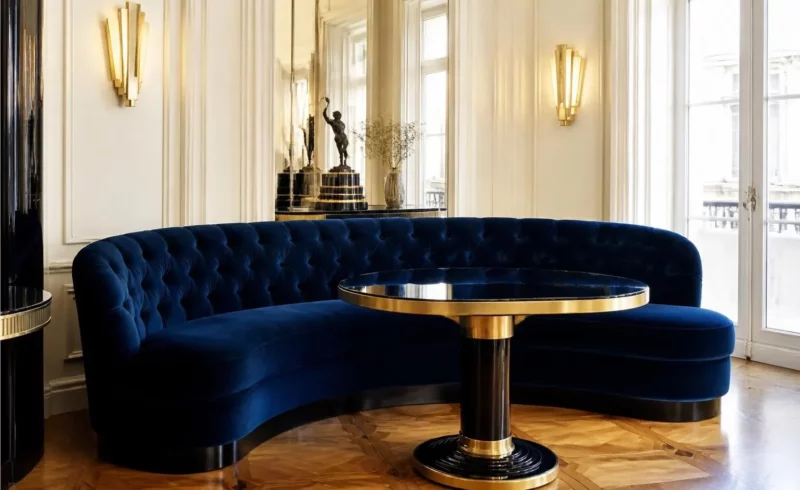
This is also where tufting shows its full potential:
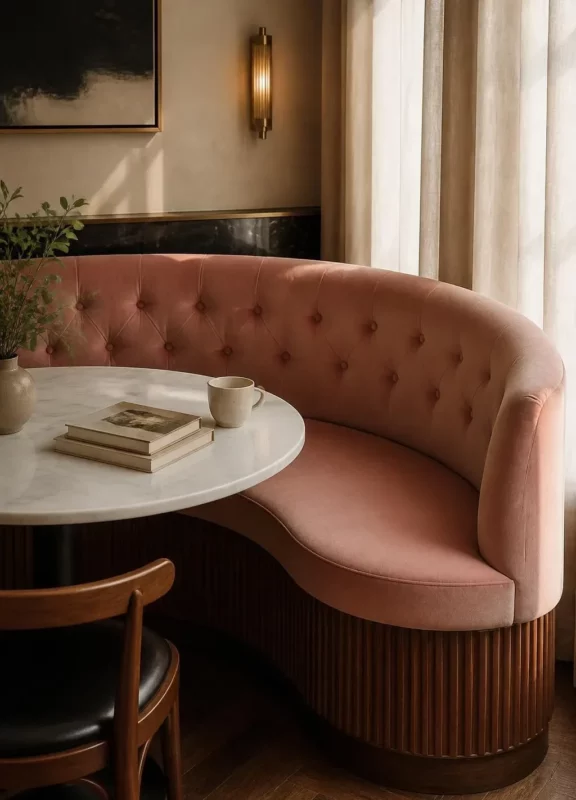
- Button tufting, in one or two rows, for a classic, well-tensioned back.
- Square tufting, for a more graphic, modern look.
- Channel tufting, vertical channels that follow the curve naturally, very popular in restaurants and bars.
- Vertical seams, for a minimalist look: the back is made of flat fabric panels sewn together, and the seams absorb the curve without deep tufting.
Approach 3: an inclined back
A back that leans back by about 10 or 11° is far more comfortable for long dinners. It can be done in two ways:
- Inclined battens. The frame itself is built at an angle.
- Wedge foam. The frame stays at right angles, and a made-to-measure wedge foam, thicker at the bottom, gives the slope. Simpler for the joiner, and the same tufting options remain possible.
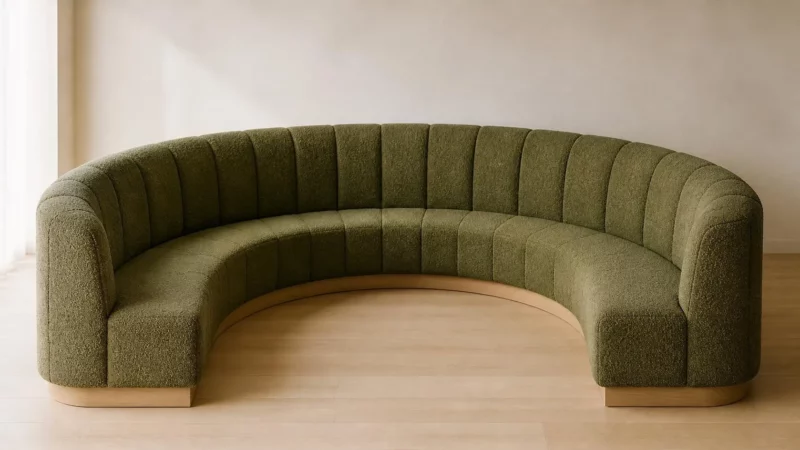
Either way, the incline must be planned from the start: it takes depth from the seat, so the seat has to be deeper. A removable inclined back cannot be added later to a banquette built with a straight back. That said, wedge foam can still give a straight frame an inclined back, as long as the back is upholstered directly on the frame.
Approach 4: a faceted frame with flat panels
Instead of one large curved panel inside the back, the joiner fixes square 4 × 4 cm battens and, on them, flat panels about 21 cm wide. Together they follow the curve as facets. Each facet stays flat, so the fabric stays taut on each panel and the joints absorb the curve. Channel tufting becomes natural, and each panel can be upholstered separately in the workshop and made removable, straight or inclined. For the joiner, it is often simpler to make than a perfect curved panel. Everyone wins.
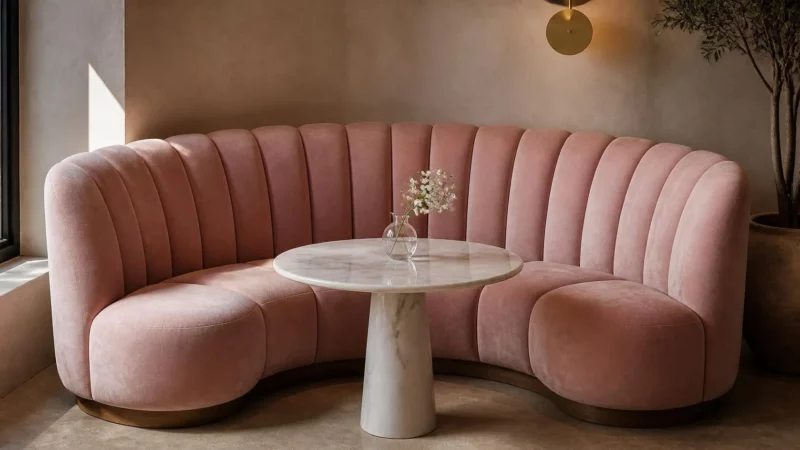
Approach 5: shaped panels for a sculptural banquette
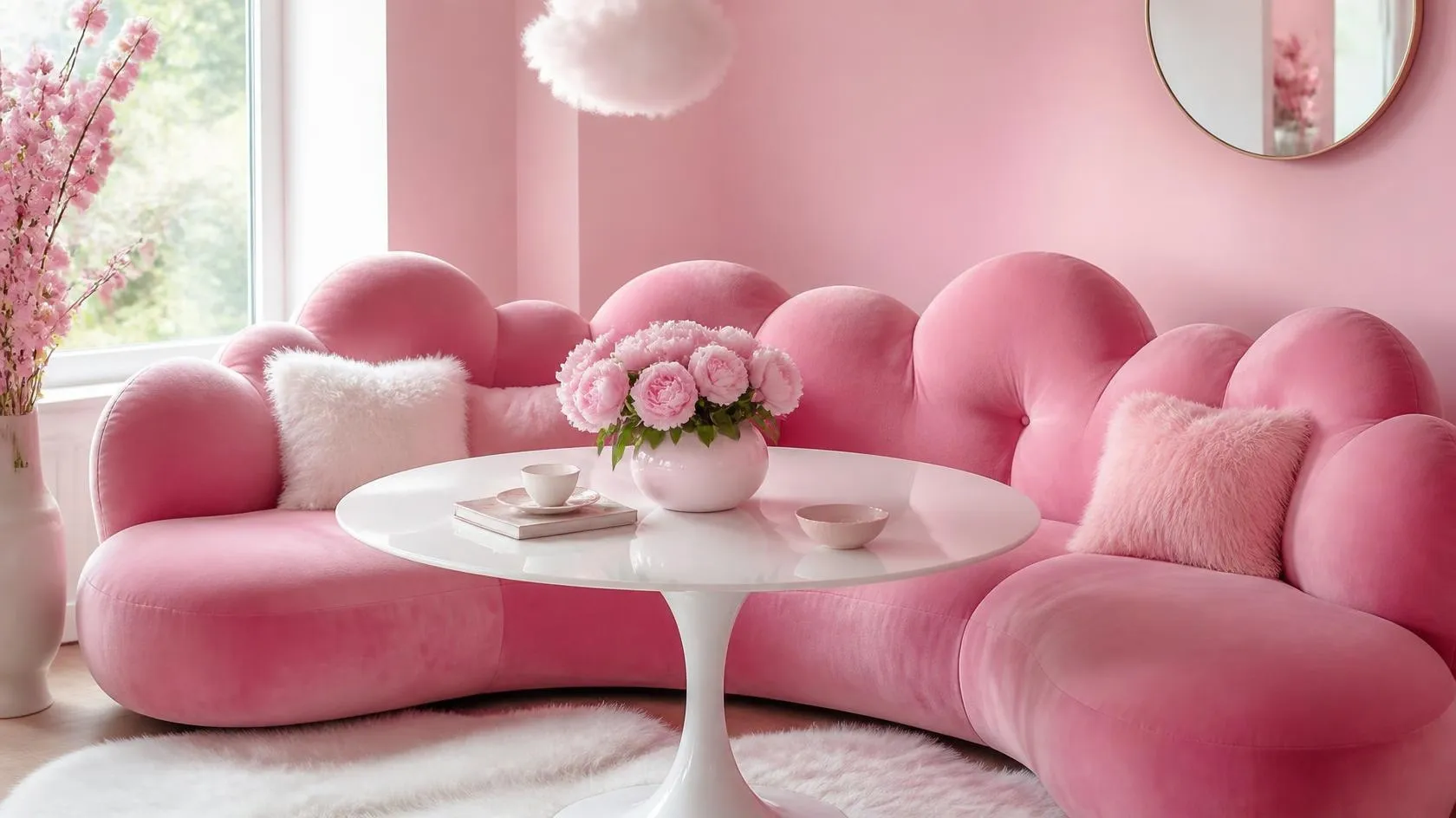
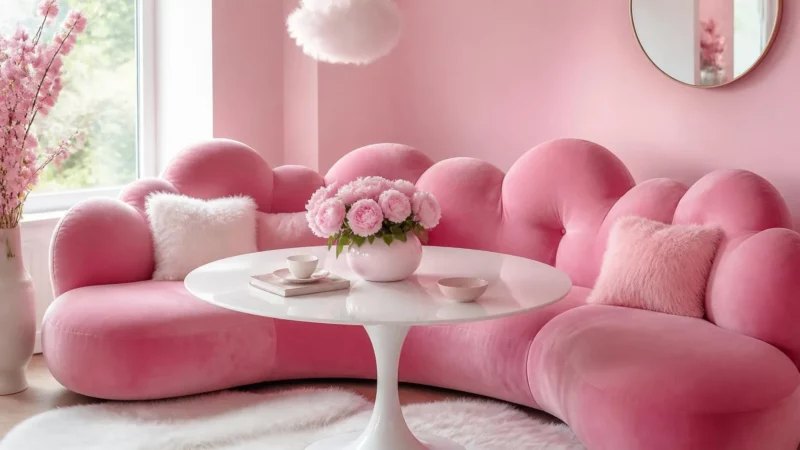
For a truly statement piece, the back can be made of special shaped panels: rounded, scalloped or cloud-like silhouettes cut from plywood, each one upholstered on its own with thick, generously domed foam, then fixed side by side on the frame. The result is a soft, curvy, sculptural banquette that looks like it was moulded rather than built.
- The curve takes care of itself. Each panel is a small independent shape, and the soft gaps between them absorb the curve. No tufting needed: the volume does the work.
- Made for XXL proportions. This approach really shines on large banquettes in big spaces: hotel lobbies, lounges, restaurants or a generous living room. On a small banquette, the shapes can quickly feel heavy.
- Practical too. Each panel is upholstered in the workshop and fixed independently, so one panel can be removed, re-covered or replaced without touching the others.
- Plan it early. The shapes are drawn first, full size, then cut by the joiner from templates. Fabric with a little stretch, a soft velvet or a bouclé, will follow the domes best.
The fabric is part of the equation
The structure is only half of the story. On a curved upholstered banquette, the upholstery fabric you choose will either help you or fight you.
- Velvet is stunning, but demanding. Its pile catches the light differently depending on its direction. On a curve, a single piece of velvet changes direction as it goes around, and the colour seems to shift from one end to the other. The darker the velvet, the more it shows.
- Bouclé is forgiving. Its loops absorb small amounts of extra fabric, which allows simpler backs on gentle curves.
- Width matters. To cover a long curved seat in one piece, check the fabric width before you order. A railroaded fabric, woven to run horizontally, can cover a long banquette without a single seam.
- A little give helps. A fabric with a slight stretch will mould to the curve more easily. A stiff, tightly woven fabric will pucker more readily and needs tufting even more.
- Durability. Banquette seating is used every day. Choose a fabric with a high abrasion rating: at least 25,000 rubs on the Martindale scale for a home, more for a restaurant or a café.
- Patterns and stripes. They are lovely, but every pattern has to line up across the tufting, the seams and the curve. Plain fabrics and textures are far more forgiving.
Joinery and upholstery are one project
People often come to me with a built-in banquette already designed and made, and I am stuck: what they ask for is either impossible or not advisable from a technical point of view. Not because anyone did bad work, but because the joinery and the upholstery were thought of separately. On simple shapes, you can get away with it. On a half-round banquette or a curved booth, you cannot. The back, the seat depth, the foam and the fabric all have to be anticipated in the structure. So my advice is simple: bring your upholsterer in before your joiner starts cutting.
A real case: the banquette that started it all
This article was born from a project in my workshop. A client came to me with a half-round banquette already built with her joiner: clean and solid work, though not finished yet, with a straight back made of one large curved panel. The original plan was a single plain back cushion, 5 cm thick, even though the frame had been built as if it were going to be fully upholstered. Ideally, it should have been upholstered directly on the frame, with two rows of buttons: pretty, and with the fabric well-tensioned.
So I studied the options: what could be done quickly on her existing frame, and how I would have designed the frame if we had worked together from the start. For members, I have put together the complete case study, with every technical proposal, front views, profile sections, top views and construction details. If you are planning your own banquette seating, it is a library of options you can show your joiner, so you both know where you are going before the first cut. You will find it in the members area.
FAQ: curved banquette upholstery
Why does fabric wrinkle on a curved banquette?
Because the upholstered face of a curved back is shorter than the frame behind it. On a banquette about 2 m across, there is roughly 16 cm of extra fabric to absorb. Without tufting, seams or a faceted frame, it forms wrinkles.
What is the best fabric for a curved banquette?
A fabric with a little stretch and a high abrasion rating: a soft velvet, a mohair or a bouclé. Bouclé is the most forgiving on a curve. Dark velvets look stunning but show every change in pile direction.
Can I add an inclined back to an existing banquette?
Not as a removable back cushion if the frame was built with a straight back. An incline needs a deeper seat and a back structure designed for it. On an existing frame, the only option is wedge foam upholstered directly onto the back.
Is tufting just decorative on a half-round banquette?
No. Buttons, squares or channels hold the fabric in place and absorb the extra length created by the curve. That is why almost every half-round banquette is tufted.
All images in this post are AI-generated illustrations, created to preview design options.