An upholstery button press is a machine that makes self-covered buttons: it presses a disc of fabric or leather around a metal shell and closes it with a back, ready to be sewn into a seat. If you want to make buttons in several sizes, choose a press with interchangeable dies: each button size needs its own set of dies, and a cheap single-size press cannot be adapted. A disc cutter in the matching sizes completes the set.
Covered buttons are everywhere in upholstery: deep-buttoned chairs, headboards, cushions, banquettes. Making them yourself means every button matches the fabric exactly. In this guide, I explain how a button press works, the button sizes, the different kinds of machines and how to choose one. The gestures themselves, making and knotting the buttons, are filmed step by step in the Hammer Club.
On this page: How it works · Button sizes · Types of machines · How to choose · Fabric and leather · FAQ
How a button press works
A covered button is made of three parts: a disc of fabric, a domed metal shell (the top) and a back, which carries the loop, tuft or prong used to fix the button to the seat. The press works with a pair of dies, one for each stage:
- Cut the disc of fabric with a cutter or a cutting die in the right size.
- Press the shell: the fabric goes face down into the first die, the shell on top, and the press wraps the fabric around the shell.
- Close with the back: in the second die, the back is pressed into the shell, locking the fabric in place.
I show the whole process on video in how to create bespoke buttons (Hammer Club members).
Button sizes: understanding lignes
Button sizes are given in lignes (L), an old unit equal to 1/40 inch, or about 0.635 mm. Each size has its own shells, backs, dies and cutter.
| Size | Diameter | Typical use |
|---|---|---|
| 22L | 14 mm (½ in) | Small buttons, fine fabrics, small cushions |
| 24L | 15 mm (⅝ in) | Deep buttoning on chairs and headboards |
| 30L | 19 mm (¾ in) | Cushions, mattresses, larger buttoned panels |
| 36L | 23 mm (⅞ in) | Decorative buttons, thick fabrics |
| 40L | 25 mm (1 in) | Large decorative buttons, floor cushions |
Types of button machines
Hand kits and small single-size presses
Inexpensive and easy to find, they make one size only, often with limited pressure. Fine for a few buttons on a single project, but frustrating as soon as you need another size or a thick fabric. This is the most common buying mistake.
Lever presses with interchangeable dies
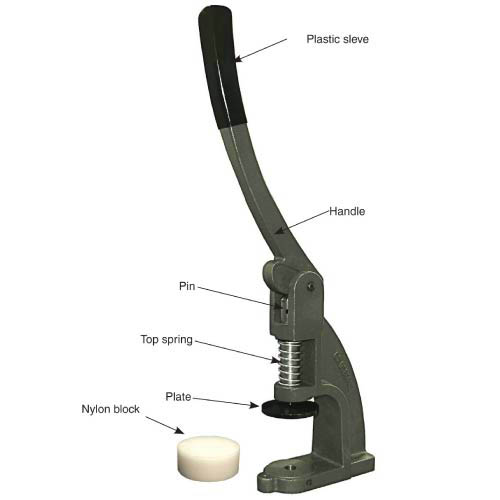
The workshop standard. The press is fixed to the bench and the dies are changed for each size, so one machine covers every size you need: you simply buy a die set, and a matching cutter, for each size. C.S. Osborne, for example, makes a lever press of this kind; it is reliable, but pressing many buttons by hand takes some effort.
Second-hand cast-iron presses
Older English button machines and cutting presses, now discontinued, regularly come up second-hand, often when an upholsterer retires and sells the workshop. They are built to last, but check that dies in the sizes you need come with the machine, or can still be found.
Pneumatic presses
Driven by an air compressor, they press each button in a second with no effort. They are made for workshops producing large quantities, and their price matches.
How to choose a button press
- Interchangeable dies: the most important point if you want several sizes. Check that the press accepts standard die sets.
- Dies and cutters available: make sure you can buy dies, cutters, shells and backs in the sizes you use, now and later.
- Your volume: a lever press is enough for most upholsterers; a pneumatic press only pays off for large quantities.
- Your fabrics: thick fabrics need enough pressure and the right dies (see below).
- Second-hand: check the condition of the dies and that the parts close cleanly before you buy.
Find where to buy machines, dies and button parts in the list of suppliers for upholsterers, and the rest of the workshop equipment in the complete guide to upholstery tools.
Covering buttons in thick fabric or leather
The thicker the fabric, the harder it is to close the button: velvet, bouclé, chenille or wool can jam the dies or leave the edge badly gathered. Cut the disc carefully to size, and test on an offcut before making the whole set. On leather, thinning the edge of the disc with a skiving knife makes a much cleaner button. And remember the pile direction on a velvet: every button must face the same way.
Button press: frequently asked questions
Can one button machine make different sizes?
Yes, if it takes interchangeable dies: you buy a die set and a cutter for each size. Small single-size presses and hand kits cannot be adapted.
What size button is used for deep buttoning?
Most often 24L (15 mm) on chairs and headboards. Larger sizes, from 30L, suit cushions and bigger panels.
Do I need a machine to make covered buttons?
For a few buttons, a hand kit can do. For regular upholstery work, a press gives firmer, cleaner and identical buttons, much faster.
Can I cover buttons in leather?
Yes. Choose a supple leather, thin the edge of the disc and test first: leather needs more pressure than fabric.
Learn to make and knot buttons in the Hammer Club
Choosing the machine is only the first step. In the Hammer Club, I show you every gesture on video, step by step, in my workshop:
- How to create bespoke covered buttons: cutting the discs, pressing and closing, even in thick fabrics.
- How to knot a button, with my apprentice: the upholsterer’s knot that holds a button firmly in the padding.