
How to Make an Upholstered Headboard
To make an upholstered headboard, you glue foam onto a plywood panel, cover it with wadding, then stretch your fabric over it and staple it on the back. It’s one of the best first projects in upholstery: no frame to strip, no springs, just a few essential techniques and a result that transforms a bedroom. Start with the simple panel below, and tell me which headboard you’d like to learn next.
| Project | Headboard |
| Versions | Simple panel · more coming |
| Level | Beginner (simple panel) |
| Technique | Modern (foam) |
| Materials | Fir plywood 18 mm (¾ in) · Foam · Wadding 100 or 200 g/m² (3 or 6 oz/yd²) · White calico (optional) · Contact adhesive · Upholstery fabric · Staples 6 to 10 mm (¼ to ⅜ in) · Tacks |
| Tools | Staple gun · Tack hammer · Foam saw or electric carving knife · Upholstery scissors · Long ruler · Pencil or marker pen · Protective mask |
| Panel size | Fir plywood, 18 mm (¾ in), at least 5 cm (2 in) wider than the mattress on each side |
| Foam thickness | 3 to 4 cm (1¼ to 1½ in), up to 5 cm (2 in) |
| Fabric | Panel size + 20 cm (8 in) on each side; one width of 140 cm (54 in) up to a 130 cm (51 in) wide panel |
On this page: Why make your own · What size · Materials · The steps · How to hang it · Coming next · FAQ
Why make your own upholstered headboard?
Because you choose everything: the exact width of your bed, the height that suits your room, the softness of the padding and, above all, the fabric. A headboard is a large, visible surface, often the first thing you see in a bedroom, and a beautiful fabric there makes all the difference.
It’s also the ideal project to learn upholstery. You work flat, on a simple shape, and you practise the gestures you’ll use on every chair afterwards: gluing foam, laying wadding, placing fabric on the straight grain, temporary tacking, stapling with an even tension and folding clean corners.
What size should an upholstered headboard be?
Always make it at least 5 cm (2 in) wider than the mattress on each side: a headboard narrower than the bed always looks wrong. As a guide:
| Mattress width | Minimum panel width |
|---|---|
| 90 cm (35 in) | 100 cm (39 in) |
| 140 cm (55 in) | 150 cm (59 in) |
| 160 cm (63 in) | 170 cm (67 in) |
| 180 cm (71 in) | 190 cm (75 in) |
Mind the fabric: most upholstery fabrics are 140 cm (54 in) wide. Up to a 130 cm (51 in) wide panel, a single piece covers it with no seam. Beyond that, you’ll need to add panels of fabric on each side, with symmetrical seams.
What materials do you need?
- A fir plywood panel, 18 mm (¾ in) thick: light and good at holding staples. Avoid MDF, which is heavy, gives off formaldehyde and doesn’t hold staples well over time.
- Foam, 3 to 4 cm (1¼ to 1½ in) thick, firmer for a tailored look, softer for a relaxed one.
- Wadding, 100 g/m² (3 oz/yd²) for a flat finish or 200 g/m² (6 oz/yd²) for a softer one.
- Upholstery fabric, and optionally white calico to protect the foam.
- Tools: contact adhesive, a staple gun, a tack hammer and tacks, a foam saw or electric carving knife, and upholstery scissors.
How do you make a simple panel headboard?
Here are the main stages. Every gesture is shown step by step, with photos and video, in the full tutorial.
- Cut the panel to size and sand the edges.
- Cut the foam slightly larger than the panel, so it rounds over the edges.
- Glue the foam to the panel with contact adhesive.
- Add a calico lining (optional) and the wadding.
- Place the fabric on the straight grain and temporary tack it.
- Staple the fabric on the back with an even tension.
- Fold the corners into a clean, sharp line.
- Finish the back and hang the headboard.
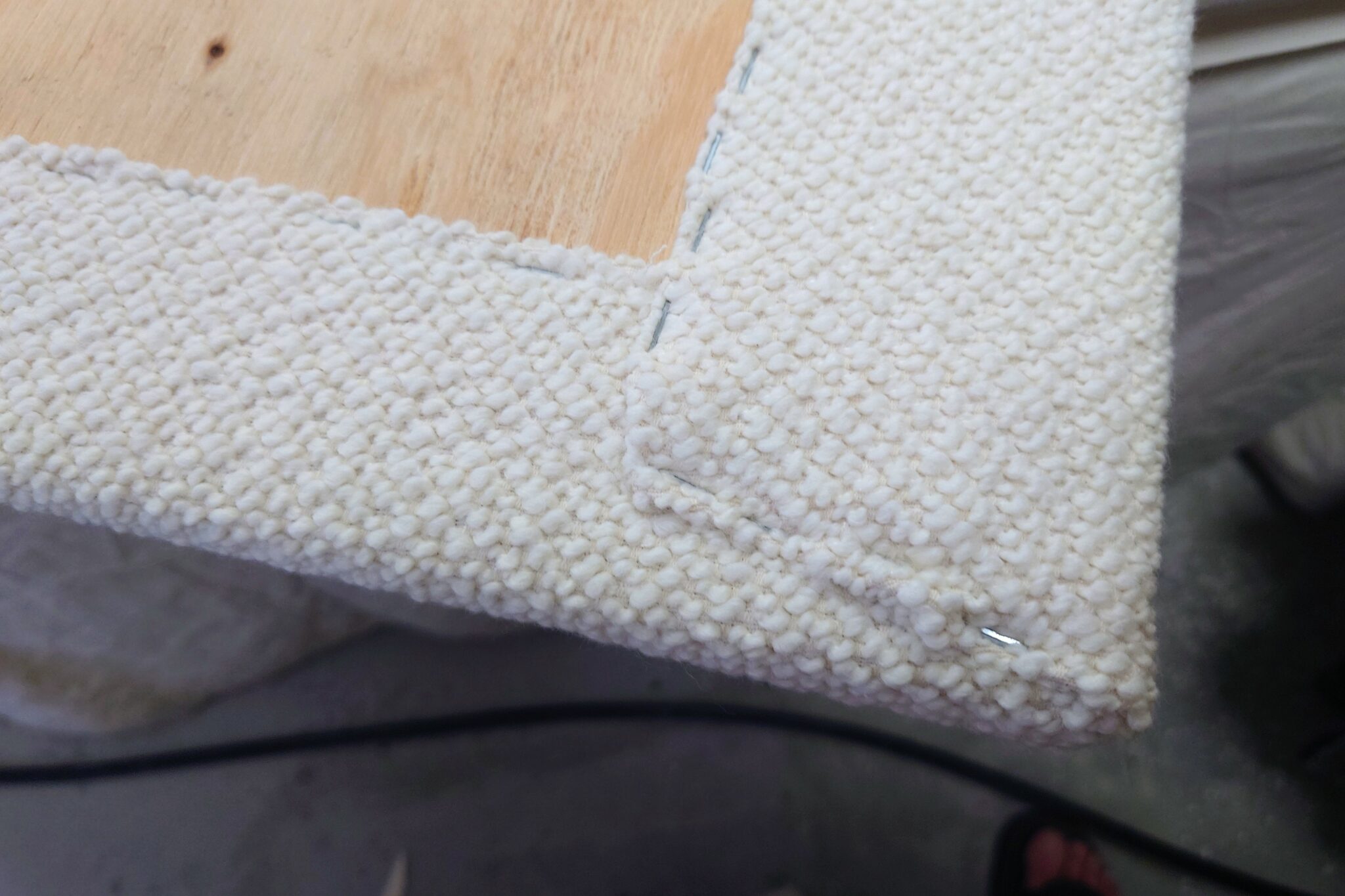
How do you hang an upholstered headboard?
You have three options. Fix it to the wall with timber battens or a French cleat, which makes it easy to move later. Fix it to the bed frame. Or slide it into built-in joinery, between shelves or within a bespoke surround: in that case, cut the panel 1 cm (⅜ in) smaller all around, to allow for the thickness of the wadding and fabric.
Which headboard would you like to learn next?
The simple panel is just the beginning. Here are the headboards I’m thinking of filming next. Tell me in the comments below which one you’d like first, or suggest your own: the most requested will be the next tutorial.
- Buttoned headboard: a classic, with buttons planned and drilled into the panel from the start.
- Channel headboard: the modern take on buttoning, with vertical or horizontal padded channels, for a graphic, contemporary look, made with the back tacking technique.
- Piped or boxed headboard: a border and piping that give the headboard depth and a tailored finish.
- Shaped headboard: curved, arched or scalloped outline.
- Headboard with a removable cover: a sewn cover you can take off and wash.
- Winged headboard: side wings that wrap around the bed.
FAQ
Can a beginner make an upholstered headboard?
Yes. The simple panel is one of the easiest upholstery projects there is, and a perfect first step before a chair. If you’re completely new to upholstery, start with Guide 1: Upholstery Tutorials for Beginners.
How thick should the foam be?
3 to 4 cm (1¼ to 1½ in) is the standard for a headboard. Go up to 5 cm (2 in) for a more generous look.
Can I use MDF instead of plywood?
I don’t recommend it. MDF is heavy, gives off formaldehyde and doesn’t hold staples reliably over time. Fir plywood, 18 mm (¾ in) thick, is lighter and much better suited.
Can I add buttons to my headboard later?
Yes Buttons have to be planned from the start: their holes are drilled in the bare panel, before the foam goes on. If you want buttons, decide before you begin.
How do you finish the edges of a headboard?
First choice: with or without a border. Without a border, as on the simple panel, the fabric simply wraps around the edge of the board and is stapled on the back: it’s the easiest finish and gives a soft, rounded outline. With a border, a separate strip of fabric covers the edge of the headboard, often with piping between the front and the border: it gives more depth and a sharper, more tailored look.
Then you can add a finishing touch, both are options: a row of decorative nails or a braid along the edge.
What is a channel headboard?
It’s a headboard upholstered in padded bands, vertical or horizontal, instead of one continuous surface: a modern version of buttoning, cleaner and more graphic. Each channel is padded on its own, and the joins are kept tight with the back tacking technique. It works especially well with plain fabrics. A channel headboard tutorial is in the list of headboards coming next: vote for it in the comments.
What fabric should I choose for a headboard?
Any upholstery-weight fabric works. Since a headboard is rarely rubbed like a seat, you can choose more delicate fabrics than for a chair: velvet, linen, a large pattern. See the upholstery fabric guide.
All the step-by-step headboard tutorials are part of the Hammer Club, alongside every other upholstery project in Guide 3: Full Upholstery Projects. To learn the whole craft, start with the complete guide on how to reupholster a chair.