When Christiane first brought me her Voltaire chair, I’ll be honest with you: I told her it probably wasn’t worth restoring. The wood was scratched, dull, coated in that thick shiny varnish you find on mass-market furniture from the early 1980s, the kind you’d spot in a big-box store catalogue rather than an antique dealer’s window. It wasn’t a precious piece. It wasn’t rare. And underneath a tired burgundy velvet, the upholstery had seen better decades.
Christiane is a loyal client and a friend at this point, so I gave her my honest take. She listened, thought about it, and said: let’s do it anyway.
I am so glad she did.
What Is a Voltaire Chair, Exactly?
If you’re not French, you might know this shape as a high back armchair, a classic French accent chair with a generous seat, curved armrests, and that tall, enveloping back that makes it look both regal and deeply comfortable. In France, we call it a Voltaire, named after the philosopher who was famously partial to his armchair.
It’s one of the most know silhouettes in French interior design, and for good reason: it works in almost any room, it ages beautifully when well maintained, and a properly reupholstered Voltaire is genuinely a forever piece.
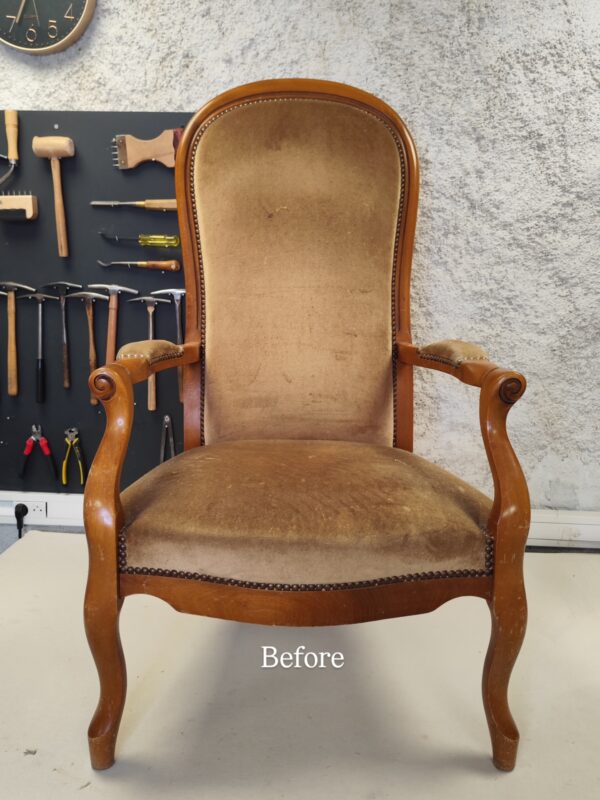
This particular one was not an antique. It came from a mass-market furniture shop sometime in the early 1980s, which is exactly why I hesitated. But a good frame is a good frame, and once we stripped everything back, this one had solid bones.
Stripping It Back to Nothing
The first decision was radical: strip everything. We kept only the bare wood frame and started from zero. That’s what we mean when we say a chair has a “healthy carcass”: a frame you can trust and build on. The bones were good even if the surface wasn’t.
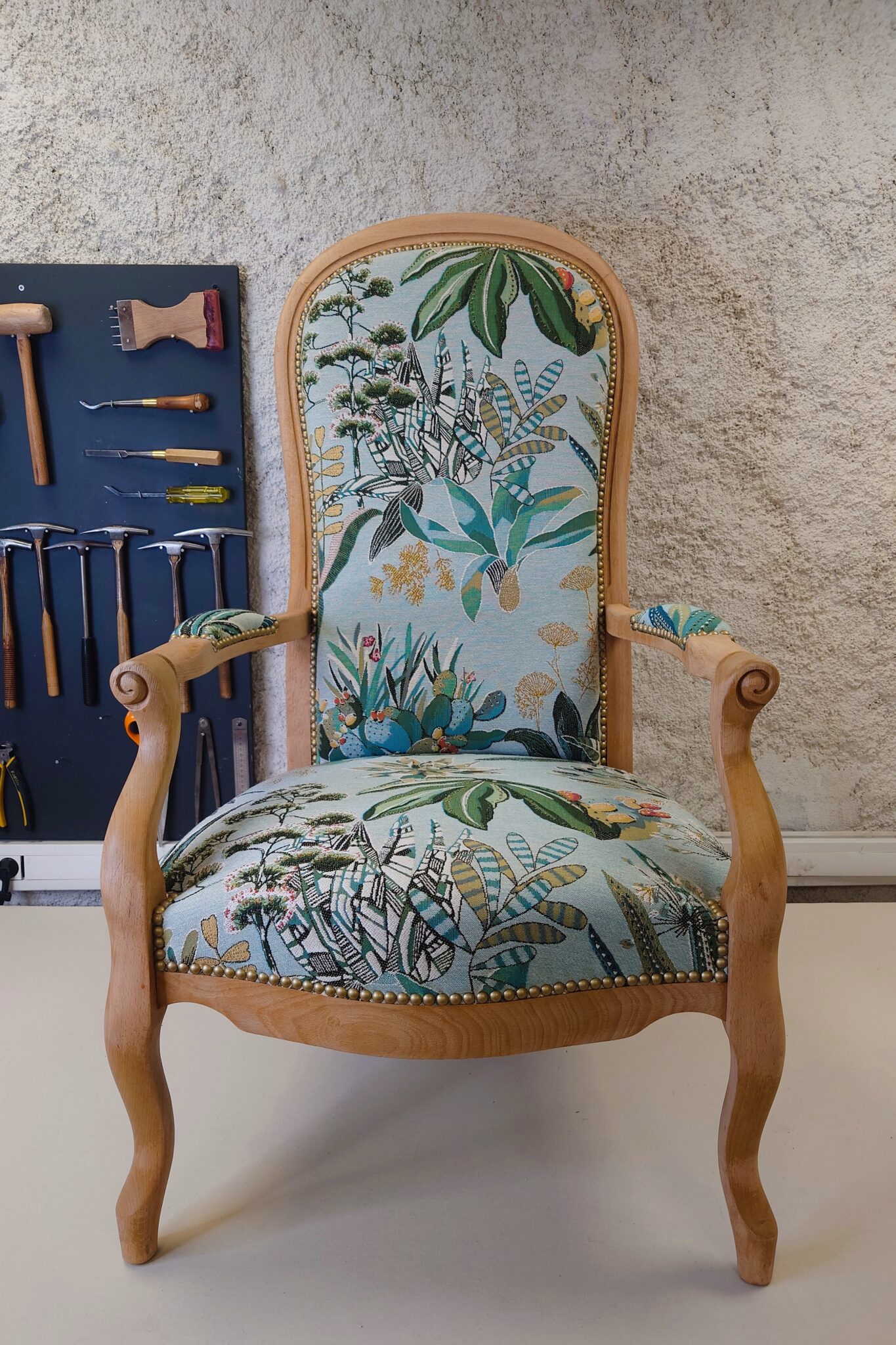
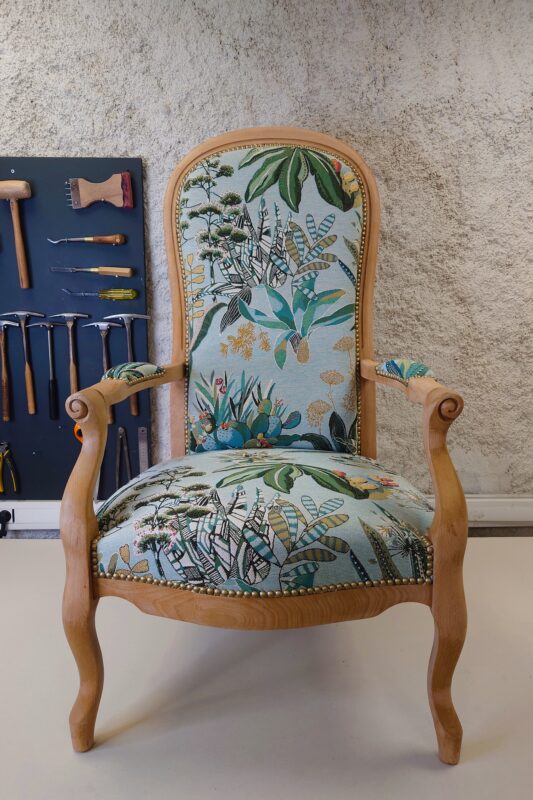
The wood itself needed real work. Christiane wanted to change the color entirely, moving away from that dark, heavy varnished oak look toward something lighter and more natural. So the frame went through a full sanding process to remove the old varnish, revealing the beech wood underneath. Beech has a beautiful pale, warm grain when it’s left to breathe. We finished it with a matte, invisible, eco-friendly varnish from Blanchon, a French brand I genuinely love for the quality and the values behind it. The result is a wood that looks like itself: natural, quiet, and elegant.
Building the Upholstery from Scratch
This is where the real work lives, and where the hours add up fast. Fifteen hours over two full days, to be precise.
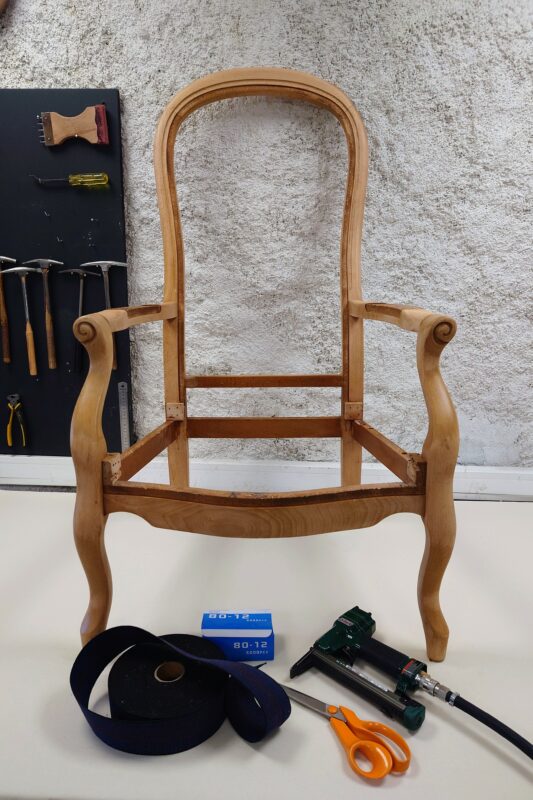
For a chair like this, I use modern upholstery techniques rather than traditional horsehair methods. The seat and back are built on elastic webbing, which gives a comfortable, responsive base that holds its shape beautifully over time. On top of that, high-resilience foam in multiple layers, shaped and calibrated to give the right support and the right silhouette. The armrests are built entirely in foam too, sculpted to follow the lines of the frame. A foam roll edge finishes the perimeter cleanly. Everything is finished with a layer of synthetic wadding before the fabric goes on, which softens the edges and gives that full, rounded look that makes a good upholstery job feel like a good upholstery job.
Want to learn how to do this on your own high back armchair? I have a full step-by-step tutorial walking you through the entire upholstery process, and a second one dedicated to the covering stage. Both are available for subscribers:
The Fabric: Maquis by Maison Lelièvre
This is where the chair stopped being a restoration project and became something genuinely beautiful.
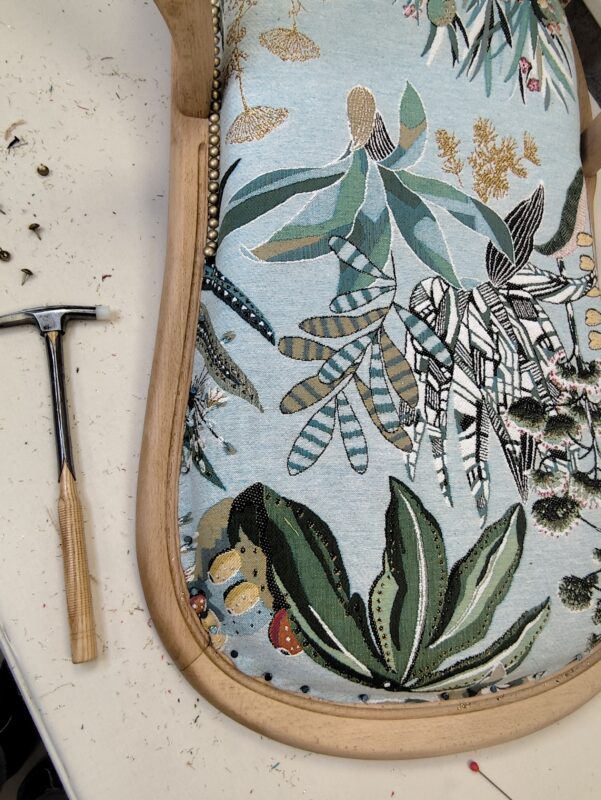
Maquis is a modern mechanical tapestry from Maison Lelièvre, one of those French fabric houses that has been doing things properly for a very long time. Mechanical tapestry is a woven fabric produced on power looms, but designed with the same graphic density and richness you expect from handwoven textiles. The pattern holds, the colors stay true, and the surface has real texture and depth. It’s a fabric that earns its place.
The design is bold: a turquoise ground scattered with cacti and succulents, with touches of gold running through. It sounds like a lot. In the right context, with the right finishing, it is absolutely stunning. The kind of fabric that makes people stop and look twice.
The Details That Pull It Together
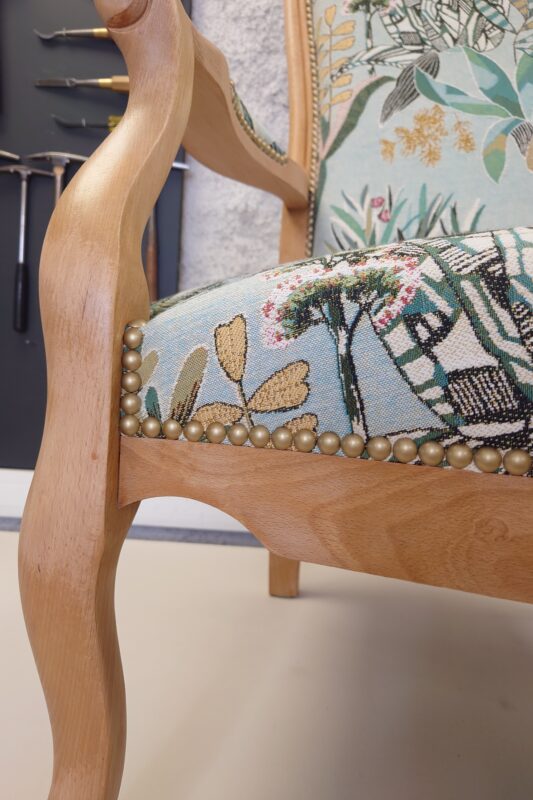
The nail trim is matte brass. Not gold, not silver, somewhere in between: warm and understated. It echoes the gold in the fabric without competing with it, and it ties back to the pale beech wood in a way that feels considered rather than accidental. Good nail trim is like punctuation. You don’t always notice it consciously, but you feel when it’s right.
What Does a Restoration Like This Cost?
Let’s talk numbers, because good work has a price and that’s nothing to be shy about. A project like this one typically requires around 2 meters of fabric and two full days of work. Fabric at this level of quality runs anywhere from 100 to 300 euros per meter, and skilled upholstery labour starts at around 500 euros per day.
The condition of the chair when it arrives makes all the difference: a healthy frame goes straight to the build, a damaged one needs extra time first. You do the math.
Christiane’s chair is now a genuinely beautiful, structurally sound piece that will last for decades. And yes, she laughs every time she remembers I told her it wasn’t worth it.
Sometimes the best projects are the ones you almost said no to.
Thinking about giving a chair like this a second life?
You can absolutely do it yourself. The membership gives you access to a full step by step tutorial covering every stage of the process, filmed in my workshop. Join and start today.