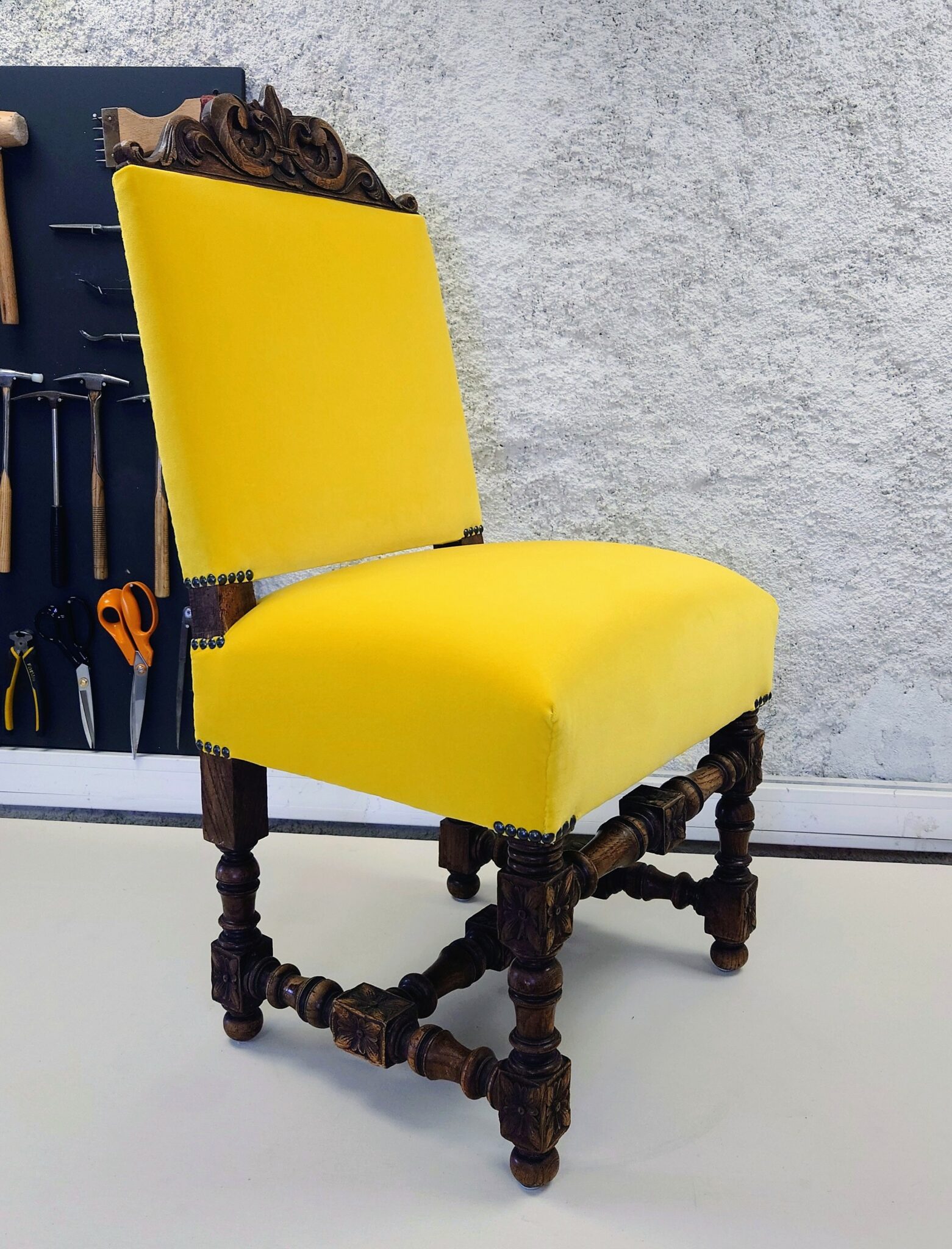
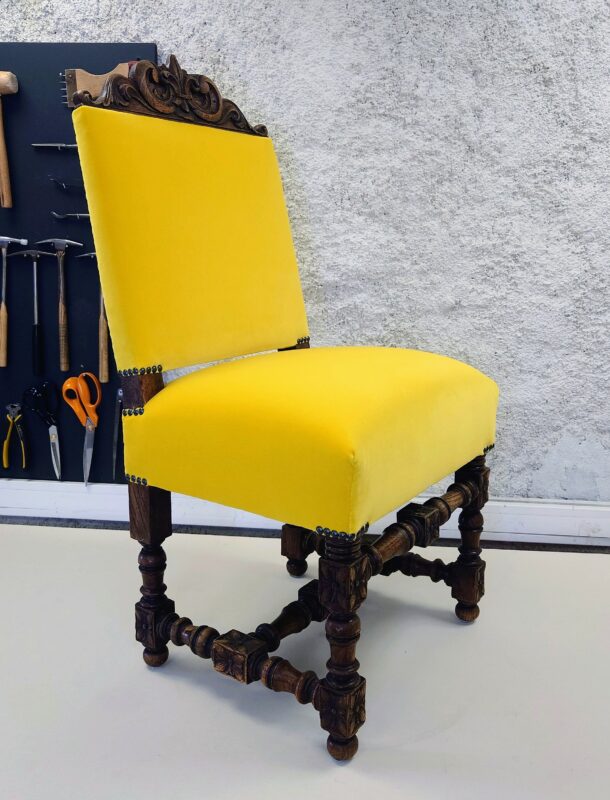
Antique chairs like this one rarely get thrown away, they get reinvented instead. A Napoleon III chair with carved oak and a fleur-de-lis worked into the wood is the kind of piece that can sit forgotten in an attic for years, or it can be given a second life, again and again, every time someone decides it’s worth reupholstering rather than replacing.
This particular chair belongs to a client of ours, an interior decorator herself, and it had already been given one second life before it ever reached our workshop.
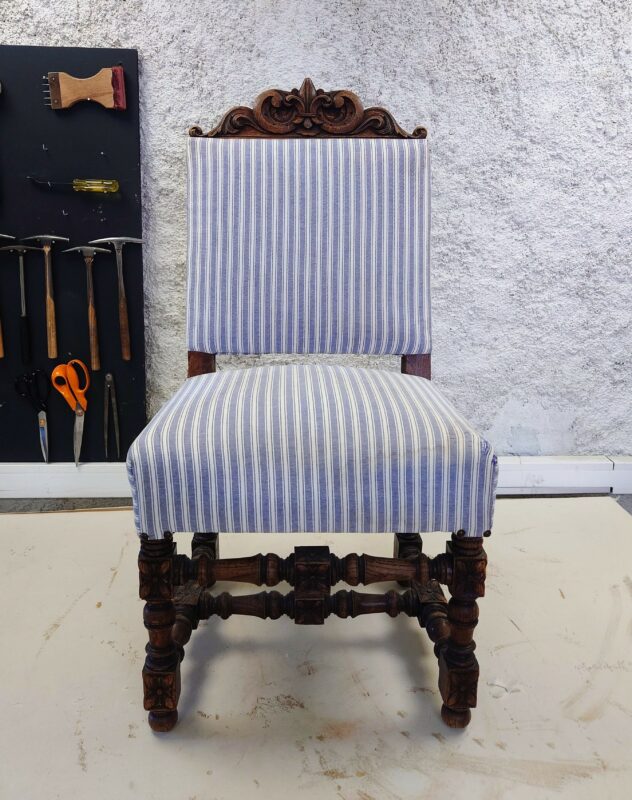
A second life, already once removed
By the time the chair reached our workshop, it had already been reupholstered once, by the client’s own mother. Stripes, minimal trim, no fuss: an early attempt at pulling a fairly grand, ornate antique chair into something more modern. It’s a lovely detail, a chair reworked by one generation and handed down to be reworked again by the next.
Our client wanted to carry that same instinct further. Not undo what her mother had done, but push it. The chair itself is rich by nature, carved oak, ornamental details, a shape that announces itself. The brief was to keep that presence but strip away anything that made it feel heavy or old fashioned.
Built for a child’s room, not a salon
This chair wasn’t headed for a formal sitting room. It was going into her youngest child’s bedroom, which changed everything about the brief. Instead of a quiet neutral, she wanted color, something joyful. We landed on a sunny yellow cotton velvet from Dedar, sitting against the chair’s natural oak tone rather than fighting it. If you’re curious about the fabric houses we turn to for projects like this one, we’ve put together a list of our favorites here.
Velvet is, in our opinion, one of the best fabrics you can put on a seat, and cotton velvet in particular is hard to beat for value. It has a soft, satiny sheen that never looks artificial, and it holds up remarkably well to both everyday abrasion and the occasional wash, which makes it a genuinely good choice for a child’s bedroom rather than just a pretty one. If you want to understand why velvet has been a go-to fabric in interior design for centuries, it’s worth reading into.
The wood was left completely untouched, its original warm oak color doing the quiet work while the velvet does the loud one. Because the chair would actually be used, climbed on, sat in, dragged around a child’s room, durability mattered as much as looks. That’s part of why the inside was rebuilt completely rather than simply recovered.
An eclectic style, borrowed from everywhere
The Napoleon III style doesn’t really have a vocabulary of its own. It’s an eclectic style, one that borrows freely from earlier periods rather than inventing its own rules: a bit of Louis XIII here, a touch of Louis XIV there, with a flamboyant, almost troubadour-like exuberance layered on top. If you want to go deeper into where the style comes from, it’s worth a read on its own.
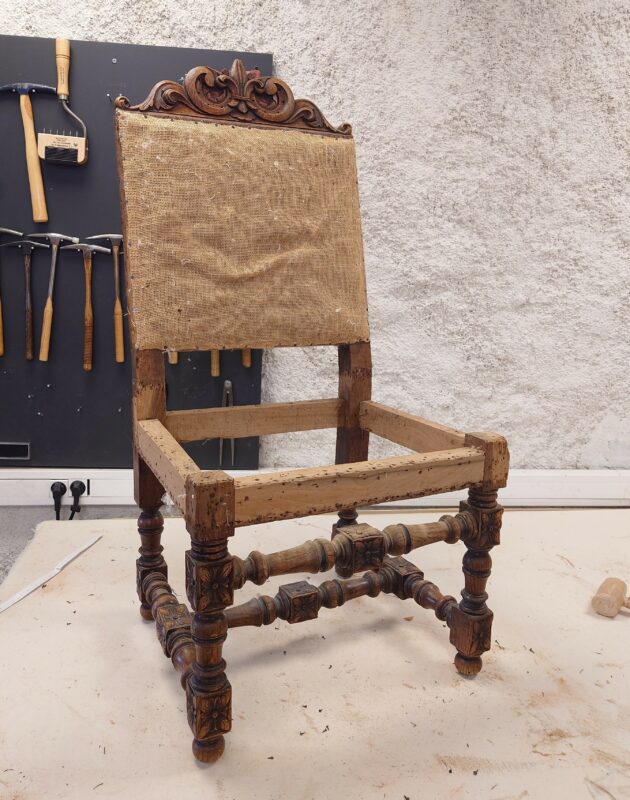
This chair is a good example of that borrowing in practice. The wood on the seat is entirely covered in fabric rather than left exposed, a detail it inherits from the Louis XIII and Louis XIV chairs it’s quoting rather than something unique to Napoleon III itself. Some chairs from this period leave the wood bare instead, cabriolet seats in the Louis XV style being the most familiar example, and that’s exactly the kind of seat where you’ll often find a wrap-around cut too. You can even spot the borrowing directly on this chair: the H-shaped stretcher between the legs is a signature straight out of Louis XIV furniture.
What was actually rebuilt
Underneath the new fabric, very little of the original chair was left as it was. The webbing was replaced, the padding was rebuilt from scratch, and we used foam over shaped profiles rather than the original stuffing. The back of the chair had also seen better days, so rather than patch it, we replaced the wood entirely with a new back panel built to the original shape.
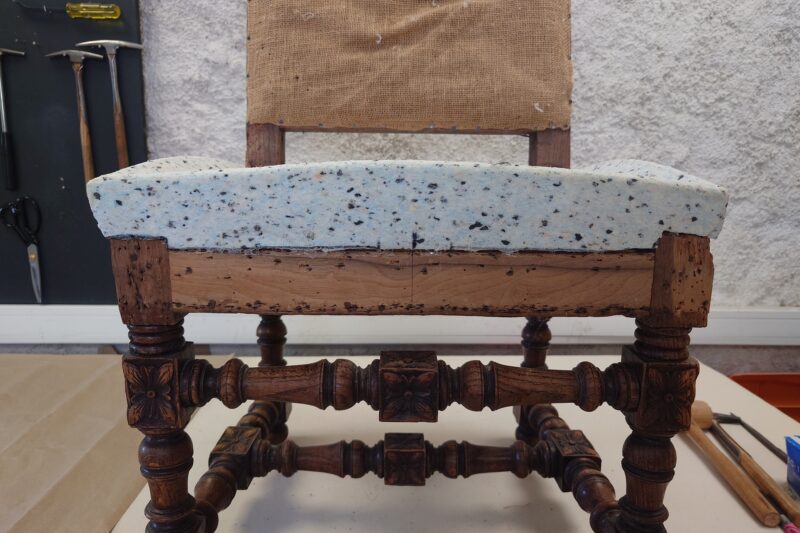
If you want to see how we approach foam shaping with profiles on a project like this, we cover it in detail here:
Minimalistic finishes
On the back, we went with a hand stitched finish, no piping, nothing breaking the clean line of the fabric. Down at the base of the back posts, just a few nails hold the fabric in place, enough to secure it without turning into a decorative trim. It’s a quiet, modern finish that lets the carved wood do the talking.
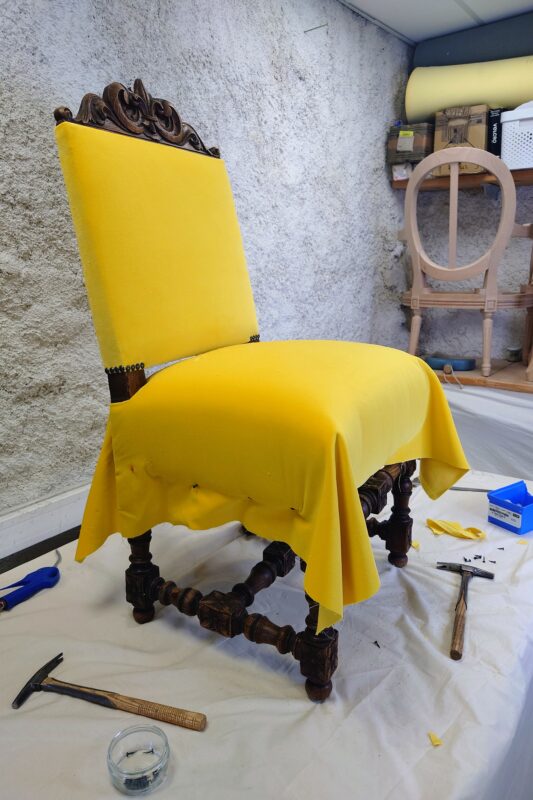
On the seat, the fabric needed to wrap cleanly around the back posts rather than leaving them bare, which is where the wrap-around cut comes in. If you’ve got a chair with a similar detail, we’ve written up exactly how to do it:
Here too, the finish stayed minimal: just a few well placed nails, used sparingly, mostly there to hold the fabric securely over time rather than for decoration. On a chair that’s going to take years of a child climbing on and off it, that small amount of reinforcement matters more than it would on a piece that just sits in a hallway.
Why reupholster instead of replace
There’s really no comparison between a chair like this one and something bought new from a big retailer, built from composite materials and cheap glue. A well built antique frame has already survived 50, 100, sometimes 200 years, and there’s no reason it can’t go another round just as long. You can rework these chairs into something completely different if you want, but more often than not, they’re already so well made that the best move is simply to bring them back to what they were.
The environmental side of it matters to us too, even if not every client thinks about it the same way. There’s also something genuinely good about putting a local craftsperson to work instead of buying new: it supports people around you instead of a factory somewhere else, and it keeps one more piece of furniture out of the landfill.
And then there’s the sentimental side, which is honestly at the heart of most of what comes through our workshop door. The chair grandfather used to tell stories from. The chair grandmother always sat in to watch television. Sometimes a chair like that is genuinely the only thing left of someone, and that’s reason enough to save it.
Frequently asked questions
How do you know if an antique chair is worth reupholstering?
Start with the frame, not the fabric. If the wood is solid, the joints are tight, and there’s no rot or active woodworm, the structure underneath is almost always worth saving, whatever the old upholstery looks like. A frame like that has already proven it can last a century, fabric and padding can always be rebuilt on top of it.
How much does it cost to reupholster a chair like this one?
It varies with the craftsperson, the amount of work the chair needs, and the fabric you choose, but as a rough guide, a full rebuild on a chair of this size, webbing, padding, foam shaping, and a hand finished cover, typically lands somewhere between 1000 and 1500 euros all included.
How long does a project like this take?
If you’re working with a skilled, reputable upholsterer, it’s normal to be looking at 3 to 6 months from first contact to finished chair. Good workshops tend to have a backlog, and that wait is usually a sign of quality rather than something to worry about.
Can you use any fabric on an antique chair?
Not quite. Some fabrics suit certain chair shapes better than others, and the way a chair is built, fixed seat versus drop-in, exposed wood versus fully covered, can rule certain fabrics out entirely. Cotton velvet, like the one used here, is a safe and versatile choice across most antique chair styles.
What is a wrap-around cut, and why does it matter?
It’s a cut that lets the fabric wrap cleanly around the back posts of a seat instead of stopping short and leaving them bare. It shows up most often on Louis XIII, Louis XIV, and Napoleon III style chairs, and sometimes on Louis XV cabriolet chairs too. Done well, it’s barely noticeable, which is exactly the point.
The result
What started as a fairly formal, ornate antique chair is now something a little more unexpected: carved oak and a fleur-de-lis next to a wall of sunny yellow velvet, in a child’s bedroom rather than a salon. Three generations of decisions on the same frame, each one giving it a second life it might not otherwise have had.
Ever had to figure out a wrap-around cut on a chair like this one and felt completely lost? Now that you’ve got the full tutorial, does it make a lot more sense?